People · c.1835–1919
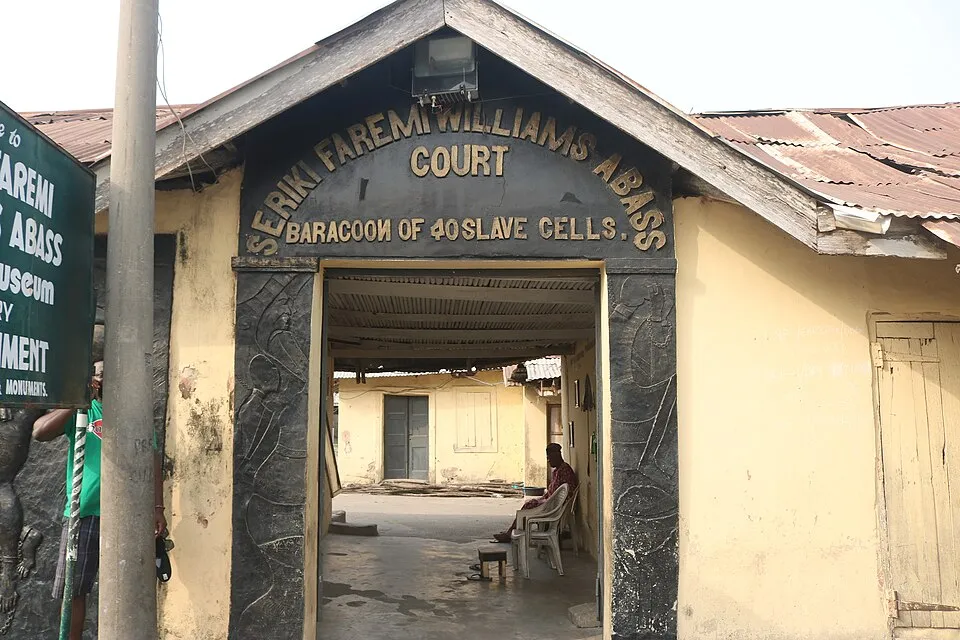
Image: Entrance of the Seriki Williams Abass museum in Mobee Badagry.jpg — Mrnyben1313, CC BY-SA 4.0 · source
A boy sold into slavery returned home and became one of the men who sold others. His story is one of Badagry's hardest lessons.
The boy was called Ifaremilekun Fagbemi. He was born around 1835 in Joga-Orile, a town in the Ilaro area of what is now Ogun State. When he was still young, raiders from the kingdom of Dahomey attacked, and he was captured. He was sold and sold again, until he ended up with a Brazilian slave dealer named Williams.
In Brazil he worked as a house slave. He was clever and paid attention, and he picked up English, Dutch, Portuguese and Spanish. His master noticed. In time Williams sent him back to the West African coast as his agent. The young man took his master's name, and later the Muslim name Abass. So Ifaremilekun became Williams Abass.
He settled first at Ofin in Isale-Eko, Lagos, and then in Badagry. There he did something that is hard to read about. He went into the same trade that had stolen his own childhood. Behind his house he kept a barracoon, a building where captives were held before being shipped across the sea. It had forty small rooms. People say up to forty captives could be squeezed into a single room, chained, waiting.
Badagry today keeps that building as the Seriki Williams Abass Slave Museum. Visitors can stand in the tiny cells and see chains and other objects from that time. Guides tell the story plainly, because it is important not to look away.
As the slave trade ended, Abass became a trader in other goods and a powerful local figure. He was given the title Seriki, a war chief title, and in 1913 the colonial government named him Paramount Ruler of Badagry. In 1919 he is said to have owned the first lorry in the whole Egbado area. He died on 11 June 1919.
Why tell this story? Because it shows how the slave trade worked. It was not only foreigners. Africans were drawn into it, sometimes people who had themselves been victims. Seriki Abass was both a captive and a captor. His building was declared a national monument in the early 2000s so that people would remember.
If you go to Badagry today, you can visit the museum and also see the mausoleum where Seriki Abass is buried. The guides are often his descendants, which makes the visit even more striking: a family telling the painful truth about its own ancestor. Many visitors also walk to the Point of No Return on the beach, where captives were taken to the ships. The walk is quiet and slow, and for many people it is the most moving part of a visit to Badagry. History is not only about heroes. Sometimes it is about people who did wrong, and why. Understanding that is how we make sure it never happens again.