Lost history · 1925–1936
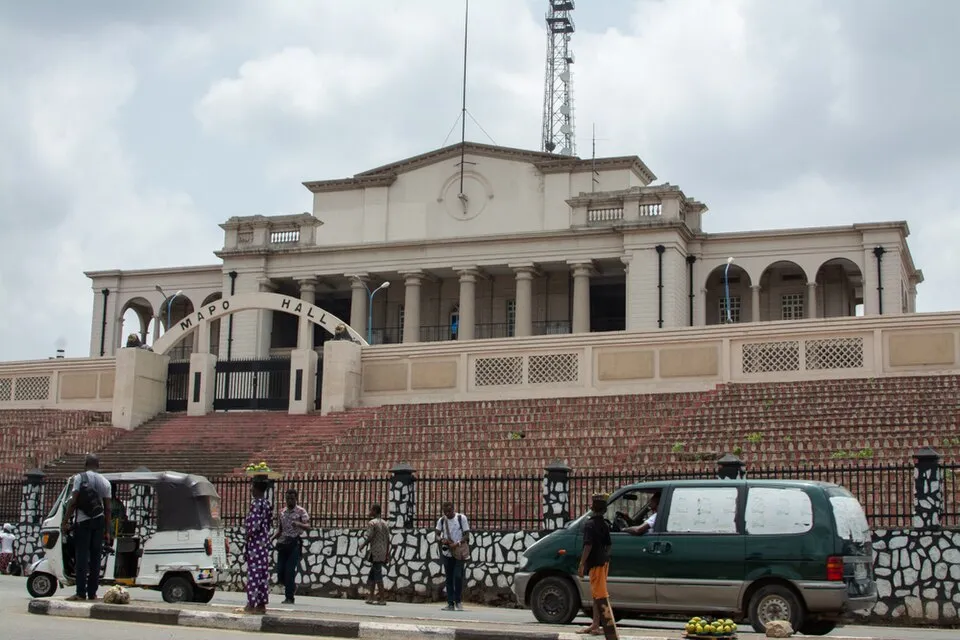
Image: Mapo hall Ibadan-0278.jpg — Olasunkanmiariyo, CC BY-SA 4.0 · source
Mapo Hall and Bower's Tower are on every Ibadan postcard. The man who built them is almost forgotten.
Stand anywhere in old Ibadan and look up, and you may see Mapo Hall sitting on its hill like a grand old uncle. It has tall columns along the front, the kind you see on old buildings in Europe. Today it is where the Olubadan is crowned and where big city events happen. But who built it?
His name was Robert A. Jones, though everyone called him Taffy, a common nickname for people from Wales. He was born in 1882 and came to Nigeria in 1910. From 1923 he worked as the road engineer for the Ibadan Native Authority. He was a builder at heart, and he left his mark across the region.
He designed Mapo Hall, and work started in 1925. The foundation stone was laid in June that year by Captain W. A. Ross. The hall took four years and cost about twenty-four thousand pounds. It was opened by the Governor, Sir Graeme Thomson, and commissioned on 5 October 1929. Jones based the look on St George's Hall in Liverpool, a famous building in England.
Here is the uncomfortable part. Some accounts say much of the labour came from prisoners, including men jailed for not paying tax. A local museum is said to keep chains from that time. We cannot prove how many workers were prisoners, but it reminds us that grand colonial buildings were not always built by willing hands.
Jones also built Bower's Tower on Oke-Are hill, unveiled on 15 December 1936. It honours Captain Robert Lister Bower, the first British Resident in Ibadan in the 1890s. The tower is about sixty feet tall, and inside a spiral staircase winds round and round to the top. That winding stair gave the tower its Yoruba nickname, Ilé Ìṣọ́ Layipo, or simply Layipo, from the idea of going round and round. From the top you can see the rusty roofs of Ibadan spread out like a sea.
Jones also built the Manor House in Iseyin. He worked in Nigeria until 1944 and died in 1949.
Ibadan people walk past his work every day, yet few know his name. That is how history often works: buildings last longer than the memory of the people who made them, and of the many workers whose names were never written down at all.
Mapo Hall has seen a lot. Politicians have made speeches from its steps, and crowds have gathered on its hill to celebrate or protest. In recent years the Oyo State government has repainted and repaired it. On the hill below it, Oja'ba market still bustles, one of the oldest markets in the city. The photo on this page shows the hall's long row of columns. Next time you are in Ibadan, climb up and stand between them. Look out over the old city and spare a thought for Taffy Jones, and for the men who carried the stones.