Legend · c. 10th century (legendary) · Tradition
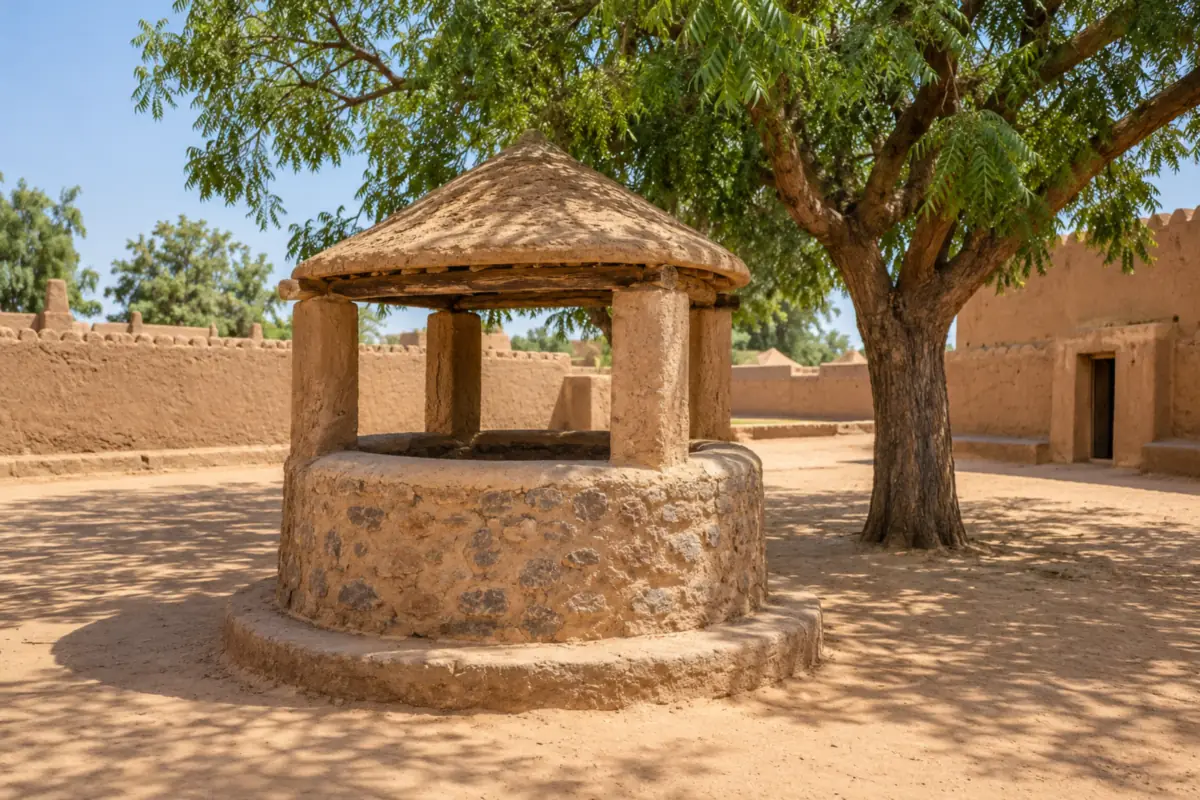
Image: Generated illustration — AI-generated for Naija Tales, reviewed for accuracy, Generated illustration, not a historical photo
The people of Daura could only draw water once a week, because a serpent named Sarki lived in the well. Then a thirsty stranger arrived on the wrong day.
In Daura, in today's Katsina State, there is an old well called Kusugu. Visitors are taken to see it, and they are also shown a blade said to have belonged to the man who made the well famous. To understand why a hole in the ground matters so much, you have to go back to the story the Hausa tell about where their kingdoms came from.
In the legend, Daura was one of the great Hausa towns, and it was ruled by queens. In the time of Queen Daurama, also remembered by the title Magajiya, the town's main water came from Kusugu. But the people could not use it freely. A serpent lived in the well. Its name was Sarki, which is simply the Hausa word for king, and it would only let people draw water once a week, on Fridays.
Picture what that means in a dry northern town. Every household rationing water for six days, every pot and gourd filled on one day and stretched until the next. In some versions of the story, people suffered and went hungry because of it. The snake did not have to bite anyone to rule them. It just had to sit on the water.
The name of the snake is the clever part. A creature called King holds a town hostage. You do not need to be a scholar to sense that the story is about power as much as it is about a reptile, about who controls what people need to live.
Into this town came a stranger. The tradition calls him Bayajidda, and it says he had come from far away, often described as a prince from Baghdad who had left home after failing to get his father's throne. He had left his wife and child at a place called Garun Gabas and travelled on. At Gaya, the story says, he had local blacksmiths make him a knife.
When he reached Daura, he went into a house belonging to an old woman, named Ayyana in some tellings, and asked for water. She could not give him enough. When he asked to be shown the well, she warned him about the serpent and explained the rule about Fridays.
He went anyway, and it was not Friday. At the well he fought Sarki, killed it with his sword, and cut off its head with the knife the blacksmiths had made. Then he drank. He put the head in a bag, went back to the old woman's house, and as far as the town knew, nothing had happened.
The next morning, the people of Daura found the headless body of the snake by the well. Nobody knew who had done it. Queen Daurama made an offer: whoever could prove he killed the serpent would rule half the town.
You can guess what happened next. Several men came forward with snake heads, but none of them fitted the body. They were chancers trying to claim a reward for somebody else's courage. It was the old woman who told the queen the truth, that her guest had done it. Daurama sent for him. Bayajidda brought out the real head, and it matched.
This is where the story turns. Offered half of Daura, Bayajidda said no. He asked instead to marry the queen. Out of gratitude for what he had done, she agreed, and the stranger became king.
Even his name is said to come from this moment. In the Hausa explanation, people called him Bayajidda because he could not speak Hausa when he arrived. The name is read as 'ba ya ji da', meaning roughly 'he did not understand before'. A foreigner who could not speak the language ended up founding a royal line.
From that marriage, the tradition traces the Hausa Bakwai, the seven original Hausa states. Their children and grandchildren are said to have ruled them, and other legends, like the story of Kano's first king Bagauda, link back to Bayajidda as an ancestor. That is why this little well carries so much weight. For many Hausa people, it is the place where their political story begins.
It is important to be clear about what is history and what is legend here. Historians, including W. K. R. Hallam, who wrote about the Bayajidda legend in the Journal of African History in 1966, treat it as folklore, a founding story rather than a record of events. There are several versions, and details like the old woman's name and where exactly Gaya was are told differently.
But the well is real, and it is still there. People still walk to it, still look down into it, and still hear the story of a town that could only drink on Fridays, and of the stranger who refused to wait.