People · 1859–1861
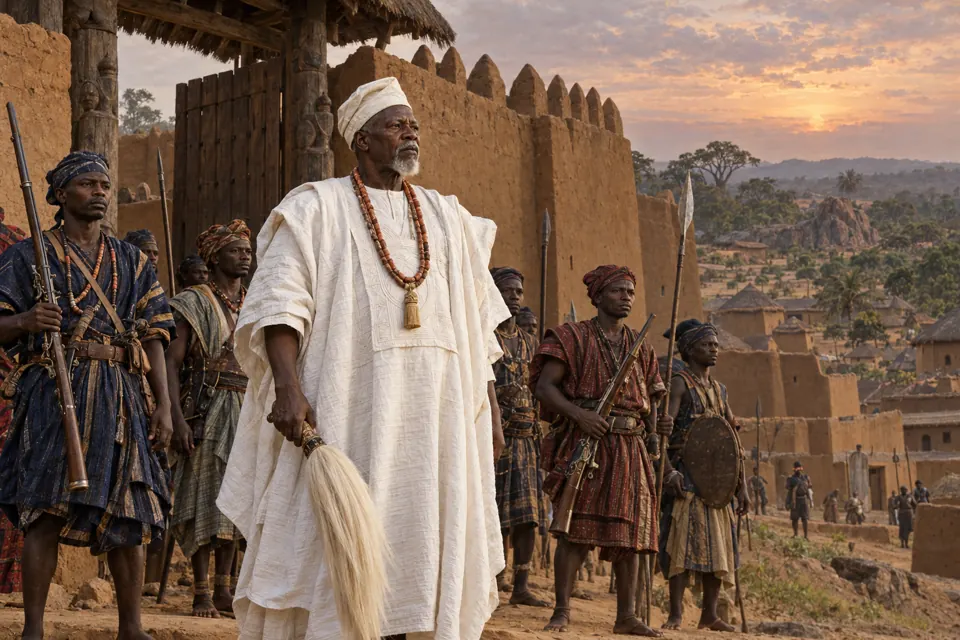
Image: Generated illustration — AI-generated with Codex image tool for Naija Tales, Generated — not a historical image
An old custom said the crown prince must die with his father. When Oyo broke it, Kurunmi went to war.
North of Ibadan, in what is now Akinyele, there was once a great town called Ijaiye. It was so big that a missionary named Henry Townsend guessed it had forty thousand people in 1852, and another visitor guessed one hundred thousand. Its ruler was Kurunmi, a tough old soldier who held the highest war title in the Oyo empire, Are Ona Kakanfo.
In old Oyo there was a hard rule. When the Alaafin, the king, died, his eldest son, called the Aremo, had to die with him. The idea was that a son who had shared his father's power should not take the throne. In 1859 the Alaafin Atiba died, and his son Adelu did not die. Instead, he was made the new Alaafin.
Kurunmi refused to accept it. To him, the custom was the law, and the law had been broken. Some say there was also old bad blood, and that he did not want to bow to anyone. Either way, he would not recognise Adelu.
The story goes that Oyo sent Kurunmi two things: an Ogboni symbol, meaning peace and talks, and gunpowder, meaning war. He was asked to choose. He chose the gunpowder. He even attacked people travelling to Oyo at a place called Jabata. Ibadan, which wanted to be the top power in Yorubaland, took Adelu's side, and war began in 1860.
The Ijaiye War was terrible. In one well-known story, Ibadan learned the drum signals that Ijaiye's army used to give orders. They beat Ijaiye's own drums to trick Kurunmi's men into a trap. His son Arawole was killed, and his head was sent to his father. In the end all five of his sons died. The Egba, who had come to help, pulled back, and Ijaiye was surrounded and starved.
Kurunmi died in 1861. Some say he took poison, some say he died at home of grief and illness, and some say he fell in battle. Only his daughter Iyagbogbo was said to know where he was buried. In 1862 Ijaiye fell and was destroyed. Today it is a small place, but the playwright Ola Rotimi made Kurunmi famous again in his 1971 play. It shows a man who would rather lose everything than give up what he believed was right.
If you visit Ijaiye today, you will find a quiet farming town off the Ibadan to Oyo road. There is not much to show that it was once one of the biggest towns in Yorubaland. Local people still point out places linked to Kurunmi, and his story is told with pride. The Ijaiye War also changed the region. It made Ibadan stronger, weakened Oyo's old ways, and pulled the British and missionaries deeper into Yoruba politics, because they took sides and wrote reports. So a quarrel over an old custom helped shape the map of south-west Nigeria.