People · 1950–2009
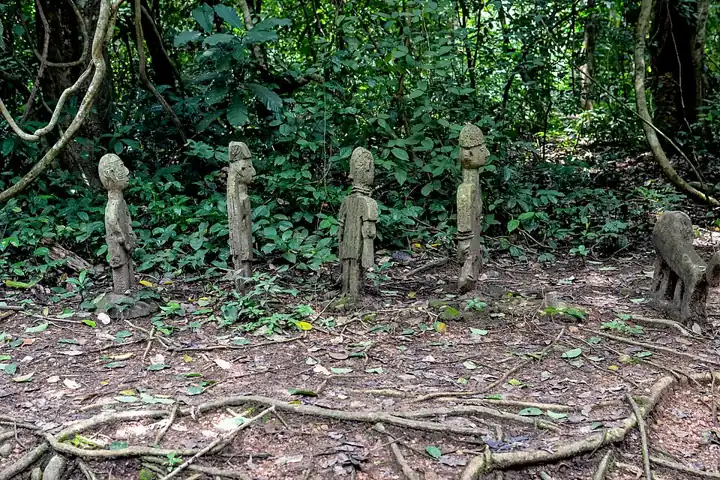
Image: Adunni Olorisha carvings at the Sacred Grove Of Oshun.jpg — Yeniajayiii, CC BY-SA 4.0 · source
A painter from Austria became a Yoruba priestess and filled the Osun grove with giant sculptures to protect it.
Susanne Wenger was born in 1915 in Graz, Austria. She was an artist. After the Second World War she met Ulli Beier, a German scholar, and they married in London in a hurry, using curtain rings because they had no proper rings. Around 1950 they came to Nigeria, where Beier had a job teaching.
They lived first in Ede, near Osogbo. Wenger fell very ill with tuberculosis, and during her long recovery she became deeply interested in Yoruba religion. She studied with traditional priests and was initiated as a priestess. She took the name Adunni Olorisha. Later she married a drummer, Chief Ayansola Alarape, in 1959. She also adopted children, including Nike Davies-Okundaye, who became one of Nigeria's best-known artists.
Just outside Osogbo is the sacred grove of the river goddess Osun. It is one of the last stands of thick forest in the area. In the 1950s it was in trouble. People were cutting trees, hunting, and fishing in the sacred river, and the old shrines were falling apart.
Wenger decided to fight for it. With local artists and builders, in a group later called the New Sacred Art movement, she spent decades building huge, strange sculptures of cement, mud and iron among the trees. Some look like gods, some like animals, some like nothing you have seen. Her idea was simple and clever: if the forest was full of sacred art, people would be afraid or ashamed to destroy it.
The grove was made a national monument in 1965. In 2005 it became a UNESCO World Heritage Site. Every August, thousands of people come for the Osun-Osogbo festival, walking to the river with prayers and offerings.
Wenger lived in an old house in Osogbo full of carvings until she died in 2009, aged 93. People called her Mama. She is a surprising guardian of Yoruba tradition: a foreign woman who did not come to take, but to protect. The grove you can visit today is, in large part, her gift and the gift of the artists who worked with her.
If you visit the grove, you walk along shady paths beside the brown river. Suddenly a giant cement figure rises among the trees, with long arms or many faces. Monkeys chatter overhead. The photo on this page shows a row of small carvings standing in the leaves, part of the art made under Wenger's guidance. Her old house in Osogbo is also full of sculptures and is looked after by the people she trained. Guides will tell you that the grove is still a living place of worship, so visitors should be respectful.