Lost history · 1921-1972
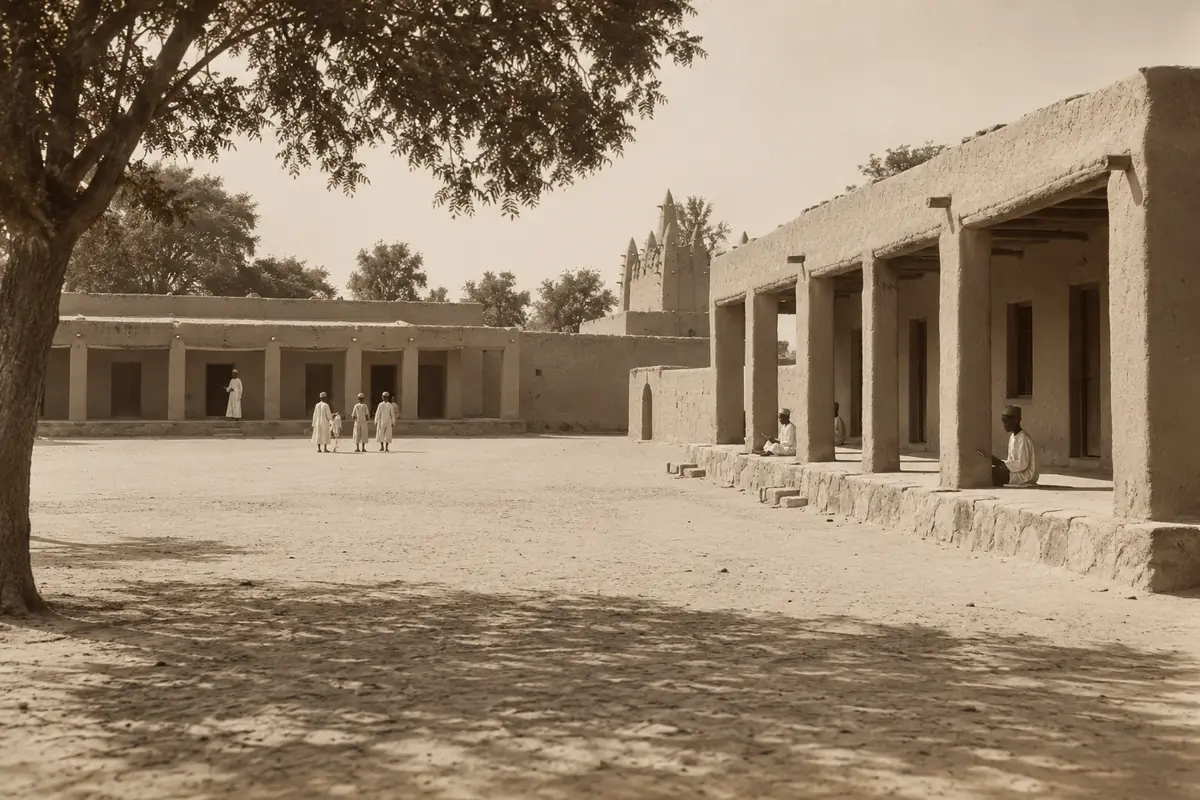
Image: Generated illustration — AI-generated for Naija Tales, reviewed for accuracy, Generated illustration, not a historical photo
Barewa College in Zaria is called the cradle of Nigerian leadership. It started life somewhere else entirely, in cheap mud buildings in Katsina, and changed its name four times before it got the one people know.
The school started as one man's worry. In the years after the First World War, the acting Director of Education for the Northern Provinces was a Briton named F. M. Urling Smith, known locally as Malam Smith. He believed the North's schools were stuck. The teachers were not being trained properly, and in his view nothing would improve until there were African teachers trained far better than the ones already in the classrooms.
Not many of his colleagues agreed. Hanns Vischer, the Director of Education whom Kano knew as Dan Hausa, had already opposed the idea of one central school more advanced than the rest. Lord Lugard had put such a college in his plans in 1917, but it was dropped for lack of money and staff. The idea only came alive when a new governor, Sir Hugh Clifford, arrived and backed it.
Even then, Clifford's reasons were narrow. He did not want to train northerners to compete with other Nigerians for government jobs. He wanted people to work for the Native Administration, the system run through the emirs. A training college for teachers looked like a safe first step.
Then came the question of where to put it. Some wanted Kaduna, the new administrative capital on the railway. Katsina won instead. It had a long reputation as a seat of learning. It was hundreds of miles from the railway, whose "exotic" influences the British feared. And it was cheap. Clifford did not want to spend money on permanent buildings, and the Emir of Katsina, Muhammadu Dikko, offered to put up temporary buildings of dried mud that would cost less and, he said, serve better. Dikko had also shown more steady support for government schooling than any other emir. The Colonial Office refused the £20,000 a permanent college would have needed, but it quickly agreed to £4,000 for temporary buildings and £500 for equipment.
By the end of 1921 the school was already running. Its first students were not children. They were young adults, some of them with families, and they came trekking or riding horses into Katsina from every corner of the Northern Provinces.
The formal opening came on 5 March 1922, with a speech from Clifford himself. He told the students to give all their energy to their training and to want nothing more than to fit themselves for teaching others. They were not to neglect their religious duties, forget their people's traditions, or fail in respect to their parents, to those in authority and to old people. Book learning on its own, he said, was worth little without good manners and good conduct.
The college aimed first at the sons of the aristocracy. Emirs and the men around them were expected to send their sons. Some did. Others found ways to keep their own children at home.
Almost all the staff were British, but two Africans held real positions. Malam Nagwamatse taught Arabic and served as housemaster, in charge of the students' quarters and their discipline. In the mid-1920s Malam Bello Kagara joined him as another teacher of Arabic and the Quran. The first principal, G. A. J. Bieneman, is remembered for planting an Eton-style tradition in a school of mud buildings on the edge of the Sahel.
In 1929 the college was upgraded, and from 1 April 1931 it took a new title, Katsina Higher College. A new Director of Education, Eric Hussey, wanted to lift the North's schools to the level of the South. The college would now offer two years of general education, then training for posts such as teachers, medical assistants and clerks. Hussey also wanted to move it. Katsina, he felt, was too far from everything.
Hussey's first choice was Zaria, where several government departments already had facilities. His plan would have cost up to £53,000 over three years. Then the Depression hit, Nigeria's revenue collapsed below £5,000,000, and the building had to stop.
A compromise came later. The Resident of Kano suggested Kaduna as a neutral site that would cause less jealousy, and it was cheaper too, because it already had electricity, piped water and housing for British staff. Money came from the Native Administrations and from a private bequest. The school became Kaduna College and moved to the northern capital in 1938.
It did not stay long. In September 1940 the British army took over its buildings for the war, and the college was pushed into railway bungalows at the southern end of Kaduna, at a place called Kaduna Junction. The principal, Eric Mort, never liked the town. He argued that boys who would serve a farming country would lose touch with reality in an artificial city. Instead of going back after the war, he arranged a move to Zaria. In 1949 the school arrived there, first as Government Secondary School Zaria, then as Government College Zaria.
That name lasted until 1972. For the college's 50th anniversary it was renamed Barewa College, after the leaping gazelle on its badge. Barewa means gazelle in Hausa.
Its old boys explain why the school matters. Ahmadu Bello, the first Premier of the North, and Abubakar Tafawa Balewa, the first Prime Minister, both studied there. So did Kashim Ibrahim, Yakubu Gowon, Murtala Mohammed, Shehu Shagari and Umaru Musa Yar'Adua. Boys from Sokoto, Borno, Adamawa, Benue and Kabba grew up together in it, and many of the men who negotiated independence had first met as classmates.
Back in Katsina, the old Katsina Training College building is now on Nigeria's list of national monuments.