Legend · Legend c.1350; held every year
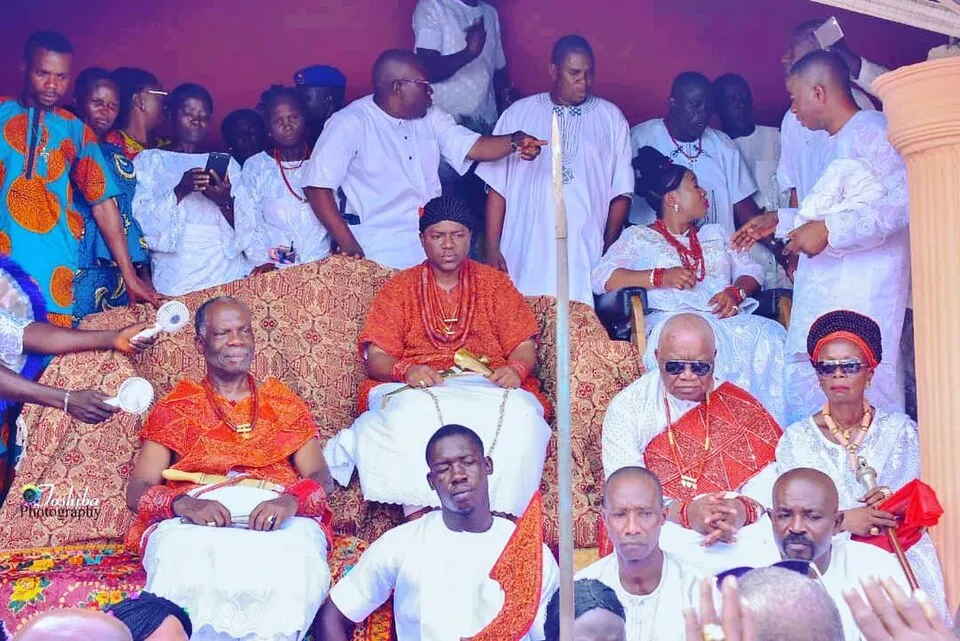
Image: Oba Ajibade Gbadegesin Ogunoye III during Igogo 2020 Festival.jpg — Gabriel Fadamitan, CC BY-SA 4.0 · source
Every September the Olowo of Owo plaits his hair and dresses like a woman, to honour a queen who walked away.
Each year, usually in September, something lovely happens in Owo, in Ondo State. The Olowo, the king of Owo, comes out with his hair plaited like a woman's. He wears coral beads and a beaded gown. His high chiefs do the same, and young men wear braids and wigs. No drums are beaten, no guns are fired, and nobody may cover their head while the king dances. Instead the town rings with the sound of metal gongs. This is the Igogo festival, and it lasts seventeen days.
Why would a king dress like a woman? The answer is a love story. Long ago, the story goes, the ninth Olowo, Rerengejen, went hunting and met a woman of great beauty. Some say she was part spirit and part human. Her name was Oronsen. He asked her to marry him, and she agreed, but she gave him a list of things that must never be done in her presence. They were taboos.
Oronsen became the king's favourite wife, and the other wives grew jealous. They found out her taboos and broke them on purpose. Hurt and angry, Oronsen left the palace. The king ran after her and begged her to come home. She would not. But she made him a promise. If he and the kings after him held a festival in her honour every year, dressing as she did and keeping her rules, she would bless the town.
So the Olowo still plaits his hair and wears her style of dress. The ban on drums and guns respects her taboos. The gongs, called agogo, are why the festival is called Igogo. Some people in Owo point out that the king's dance stops at set places, as if he is still looking for his lost queen.
One Owo historian compared it to the Taj Mahal, the famous tomb an Indian emperor built for his wife. The difference, he said, is that the Taj Mahal is stone, but Igogo is alive and is danced again every year.
Is Oronsen real? Owo tradition places Rerengejen's reign in the 1300s, with one source giving the years 1350 to 1356. But there is no written record from that time, so the queen herself belongs to legend. The festival, though, is very real, and you can see it with your own eyes. It is one of the few places in Nigeria where a king publicly says, in his dress and dance: I am sorry, and I remember.
Owo itself is an old and proud kingdom. It has deep links with the Benin kingdom to the east, and its carvers and ivory workers were famous for centuries. The National Museum in Owo holds treasures from its past. The photo on this page shows the current Olowo, Oba Ajibade Gbadegesin Ogunoye III, during the Igogo festival of 2020, surrounded by his chiefs. If you visit in September, you will find a town full of colour, coral, laughter and the steady sound of gongs.