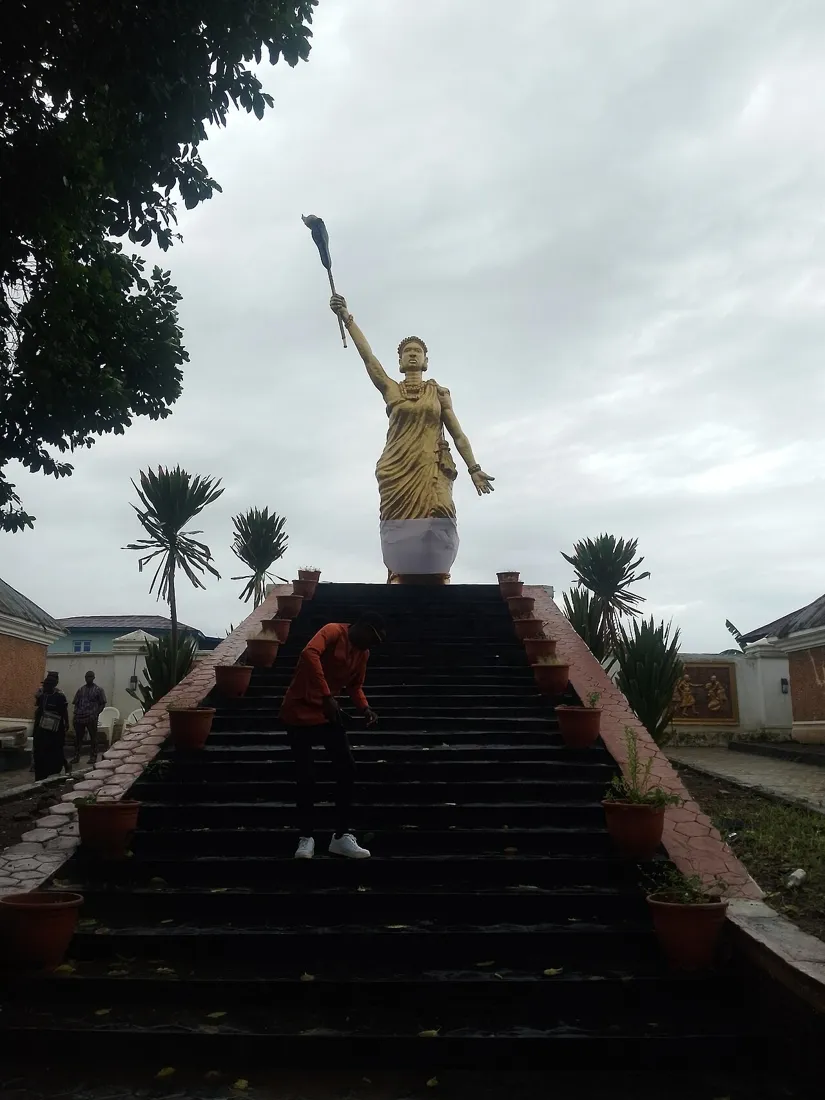
Lost history · 1953
Image: Bode Thomas Surulere Lagos.jpg — Seun alone, CC BY-SA 4.0 · source
A brilliant Lagos lawyer, a proud king, and a death that people still argue about seventy years later.
If you have ever sat in traffic on Bode Thomas Street in Surulere, you have been honouring a man most Lagosians cannot describe. Olabode Thomas was born in Lagos around 1919, studied law in London and came home in the 1940s as one of the sharpest young barristers in the colony.
He did not stay in the courtroom for long. He helped found the Action Group, the party Obafemi Awolowo built in the West, and by the early 1950s he was serving as a central minister in Lagos while still in his early thirties. People spoke of him as a future premier.
Thomas's family roots were in Oyo, and in 1949 he was honoured there with the chieftaincy title Balogun of Oyo. By 1953 he had become chairman of the Oyo Divisional Council, a seat the Alaafin of Oyo, Adeyemi II, had held before him. Picture that for a moment: a young party man from Lagos now presiding over a council where one of the oldest thrones in Yorubaland sat as an ordinary member.
Politics made it worse. Thomas was a leader of the Action Group, while the Alaafin leaned toward the rival NCNC. The two men were already pulling against each other over taxes, party loyalty and how much power a traditional ruler should keep.
Here history turns into legend. The popular story says that on 22 November 1953, when Thomas walked into the council meeting, every councillor rose except the elderly Alaafin. Thomas demanded to know why the king had stayed seated. The Alaafin, stung, is said to have replied in Yoruba: is it me you are barking at like a dog? Then keep barking.
That night, the story goes, Thomas began to bark at his home in Lagos. He was rushed to Ijebu-Igbo for treatment and died there the next day, 23 November 1953. He was 34, and it was his daughter's second birthday. For many people in Oyo and Lagos the lesson was obvious: you do not insult the Alaafin.
His friend and physician, Dr Moses Majekodunmi, told a plainer story in his autobiography. Thomas, he wrote, came back from Oyo with a fever that grew so bad on the road that he became delirious and was talking wildly. Frightened, Thomas asked that no remedy be given to him unless his doctor approved it. Fever and delirium, not barking.
So what can we say? A gifted young minister died suddenly in 1953, a day after a tense meeting in Oyo, and a busy street in Surulere keeps his name. Nobody can prove what was said in that room. The legend survives because it sits exactly where Nigerians have long felt two kinds of power meet: the new power of party politics and the old power of the throne.