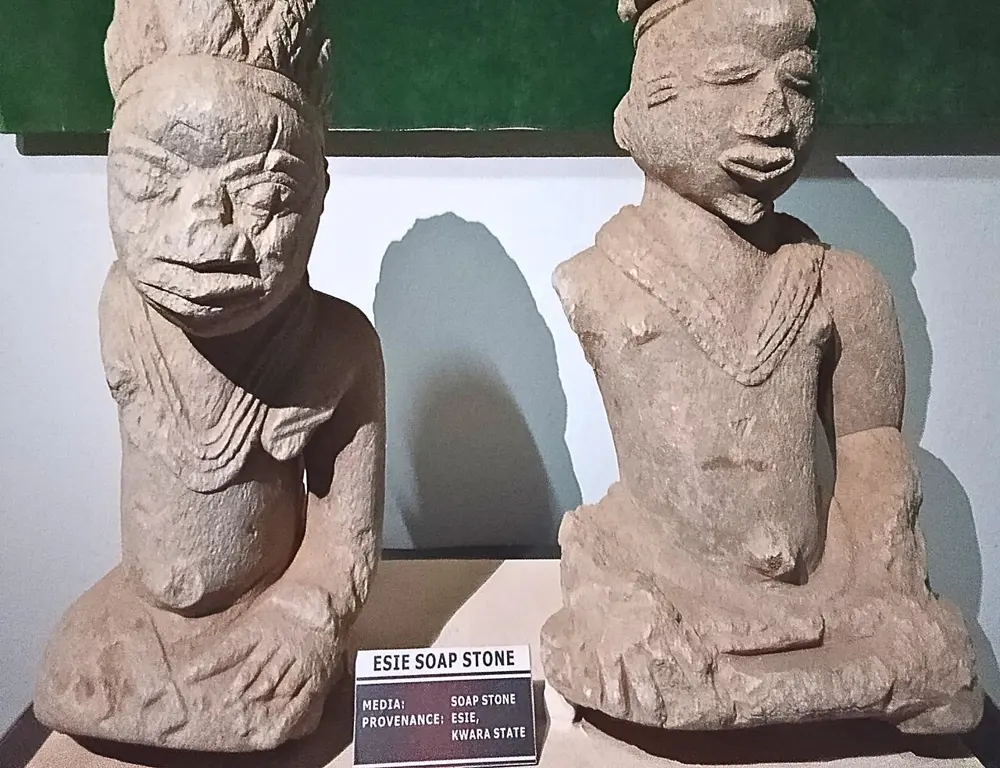
Legend · Undated carvings; museum opened 1945
Image: Esie Soap stone.jpg — CloudyMyst, CC BY-SA 4.0 · source
Hundreds of stone figures with human faces sat in a grove outside Esie. Nobody knows who carved them. The town says they were once alive.
Outside the town of Esie, in the Igbomina country of Kwara State, there was once a grove full of people made of stone.
Hundreds of them. Some sat on stools. Some held tools or weapons. Nearly all had careful faces, with tribal marks, beads at the neck, tall headdresses. Every one had been carved by a human hand from soft soapstone. Nobody in Esie knew who had done it, or when.
So the town told a story. These were people once, it said. Some tellings say they were strangers from far away who came and were turned to stone. Others say they rebelled against the king of the town and were punished where they stood. Either way, the figures in the grove were not art. They were a crowd that had been frozen.
People in Esie had always known about the figures. The wider world heard of them in 1933, when a mission school inspector named H. G. Ramshaw wrote about them. In 1945 the colonial government put up a building to protect them. That building became Esie Museum, the first museum in Nigeria.
A roof was not the same as care, though. When a young American, Phillips Stevens Jr., came to work for Nigeria's antiquities department in 1965, the building was falling apart and many figures were broken. He spent years recording them, mending them and overseeing a new museum. Esie later made him a chief.
The figures have been counted, photographed and studied, and the best answer anyone can give is still: we don't know. Their makers left tool marks but no names. Nobody can say for certain why so many were gathered in one grove.
That is part of their power. Walk among them and you see one with a chipped nose, another with a necklace cut bead by bead, another staring off to the side. Somebody thought each of those details worth hours of work.
The legend says they were people. In a way, the legend is right.