People · 1903–1963
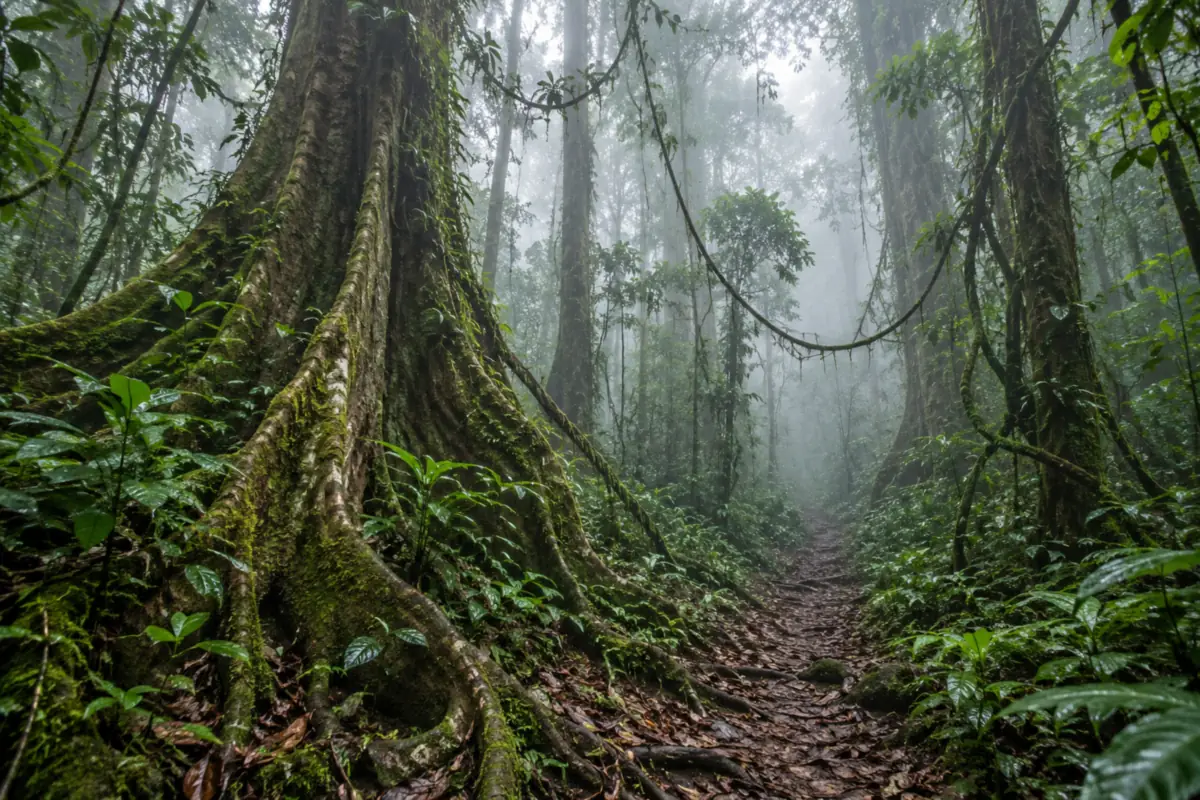
Image: Generated illustration — AI-generated for Naija Tales, reviewed for accuracy, Generated illustration, not a historical photo
In 1938 a teacher from Oke-Igbo entered a government writing contest and produced what is widely called the first novel in Yoruba. Twenty-five years later he drowned at a river crossing on his way home.
Daniel Olorunfemi Fagunwa was born in 1903 in Oke-Igbo, in what is now Ondo State. Oke-Igbo itself was young. After a war between Ondo and Ife ended, warriors were allowed to settle in a new place they called Oko-Igbo, the farm in the forest, and the name later became Oke-Igbo. His family had come there by a winding road.
His paternal grandfather, Egunsola Asungaga Beyioku, was an Ifa priest from Origbo, near Ipetumodu. Asungaga's children kept dying young, the kind of loss Yoruba people explain with the idea of abiku, children who come and go again. Asungaga had been an abiku child himself, so the family story goes. He moved to Ile-Ife in the 1870s and became herbalist and Ifa priest to the man who would later be Ooni Ologbenla. His wife, Fagunwa's grandmother, was said to be a daughter of the Olowu of Owu, from before the Owu people moved to Abeokuta. Further back stood a warrior, Faniyi Arojo.
So the boy was born into a house soaked in the old religion. His first name was Orowole, a name that points to Oro, the bullroarer deity whose voice is heard at night. When his parents became Christians, somewhere in the late 1910s or early 1920s, he took a new name, Olorunfemi, which means God loves me. That double inheritance, the forest of the orisa on one side and the mission church on the other, would end up at the centre of everything he wrote.
He went to St Luke's School in Oke-Igbo from 1916 to 1924, then stayed on as a student teacher. From 1926 to 1929 he trained at St Andrew's College, Oyo, the great Anglican teacher college of the West. On a holiday in Modakeke in 1931 he met the woman he would marry. They courted for six years before the wedding in 1937. Through the 1930s he ran the nursery section of the practising school at St Andrew's. He was, in other words, a careful, ordinary mission teacher. Nothing in that record says he was about to change Yoruba literature.
In 1938 the education authorities ran a literary contest, and Fagunwa entered. What he sent in was Ogboju Ode ninu Igbo Irunmale. It is widely described as the first novel written in the Yoruba language, and one of the first novels written in any African language at all. The CMS Bookshop in Lagos published it the same year.
The book follows a hunter into a forest full of spirits and strange beings. That was not an accident of taste. Fagunwa's heroes are usually Yoruba hunters, and in his stories they meet kings, wise men and even gods along the way. Anyone who grew up hearing evening folktales would recognise the furniture: talking creatures, tests, tricks and long proverbs. Fagunwa took that oral storytelling, with its idioms and its love of the supernatural, and set it down as a written novel. He is often credited as the first Nigerian writer to carry folk philosophy into fiction this way.
He did not stop at home-grown material. He was happy to borrow from Greek myths and from Shakespeare. In Igbo Olodumare, published in 1949, a character with a wonderful name, Baba-onirugbon-yeuke, tells a tale that looks a lot like Romeo and Juliet. Running under all of it is the tension of his own life, the pull between the Christianity of the missions and colonisers and the traditional religion of his grandfather.
Meanwhile his teaching career kept him moving. He taught in Owo, then at CMS Grammar School in Lagos, then at a girls' school in Benin, then at Igbobi College while it sat in Ibadan during the Second World War. From 1946 to 1948 he was in Britain on a British Council scholarship, and he wrote a two-part account of that journey, Irinajo. More novels followed: Ireke Onibudo in 1949, Irinkerindo ninu Igbo Elegbeje in 1954 and Adiitu Olodumare in 1961. In 1955 he took a job as an education officer in the publications branch of the Western Region's ministry. He won the Margaret Wrong Prize in 1955 and was made an MBE in 1959.
By 1963 Fagunwa was working for the publisher Heinemann. On 7 December he was coming home to Ibadan from a business trip in the North and had reached Bida. He and his driver got to the River Wuya early and joined the queue for the pontoon that carried people and cars across. While they waited for the service to open, he went for a walk along the bank. A piece of earth gave way under his foot and he slipped. A canoe nearby turned over on top of him and held him under the water. He drowned.
His body was found two days later. It was taken to Ibadan and then on to Oke-Igbo, where he was buried in the cemetery of St Luke's Anglican Church, the church of the school where he had first learned to read. He was about sixty. He had already been given a chieftaincy title before he died.
His books lived on in a way few African books do. In 1968 Wole Soyinka translated the first one into English as The Forest of a Thousand Daemons. Since then it has been put into Italian, French and Turkish, and Soyinka also translated Igbo Olodumare as In the Forest of Olodumare. Other scholars translated the rest. Fagunwa is still the most widely read author in the Yoruba language, and he shaped later writers, Amos Tutuola most famously, whose own forest tales owe a clear debt to him.
At home in Oke-Igbo there are two schools named after him, Fagunwa Memorial High School and Fagunwa Grammar School. Every year writers' societies hold Fagunwa Day, once called Fagunwa Night, to read and promote his five novels. It is a fitting kind of memorial for a man who took the stories people told by firelight and showed that they could fill a whole book.