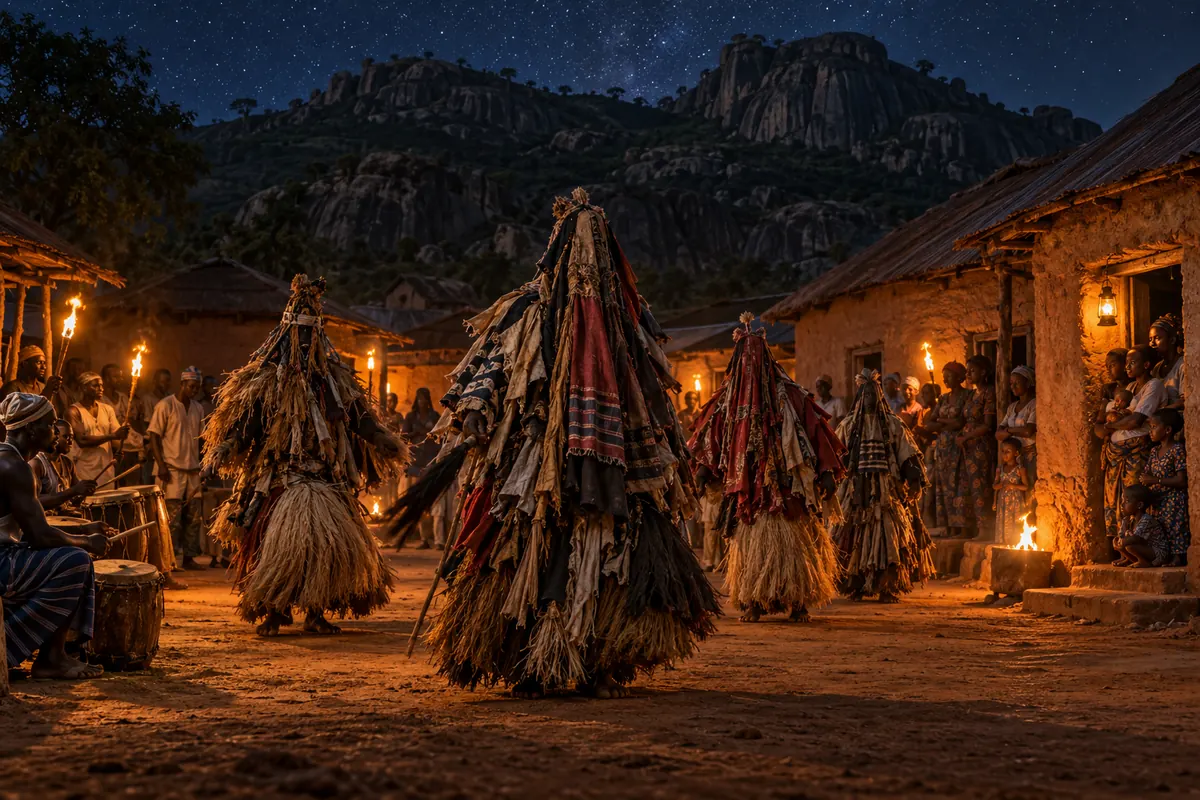
Custom · Annual year-end festival
Image: Generated illustration — Generated with an AI image tool for this site, Generated illustration, not a historical image
In Ebiraland, night songs welcome the ancestors home, and a masquerade may deliver a warning the living would rather avoid.
Every year, as the Ebira year turns, the people of Okene and the towns around it go home. They are not the only ones. According to Ebira belief, the dead come home too.
That is what Ekuechi means. Eku is the ancestral masquerade. Chi means to come down. For one night in each community, the ancestors descend from the other world and walk among the living, through the masquerades. Each community picks its own night, so the season runs from late November into early January.
By day it is an ordinary homecoming. Relatives arrive from Lagos and Abuja, friends catch up, food is cooked in big pots. Then the sun goes down and the drums start.
All night the Eku perform in the torchlight, drumming, chanting and above all singing. Some are covered from head to foot. The most famous singer, Eku'rahu, wears no mask at all, but he is still Eku.
The songs praise. They advise. And they mock. A big man in the crowd may be nodding along, enjoying the performance, before he realises the joke is about him: his meanness, his bad behaviour, his unpaid debts. Everyone else realised a verse ago.
Because the masquerades speak for the dead, the warnings carry weight. Your grandfather, it seems, has noticed how you treat your wife.
Not everyone gets to watch. A study published in 2001 found that women were generally kept away from the main night performance, apart from certain ritual roles.
Most Ebira today are Muslim or Christian, and ancestral rites sit uneasily with both faiths. Some people stay away. But the music has been hard to give up. The same 2001 study found churches and Muslim groups borrowing Ekuechi's tunes and rhythms for their own songs.
So the festival lives on in more than one form. For some it is still a meeting with the dead. For others it is music, family and being home for the holidays. Either way, someone in Okene is listening for their name in tonight's songs.