Legend · c. 1232 (tradition) to 2004
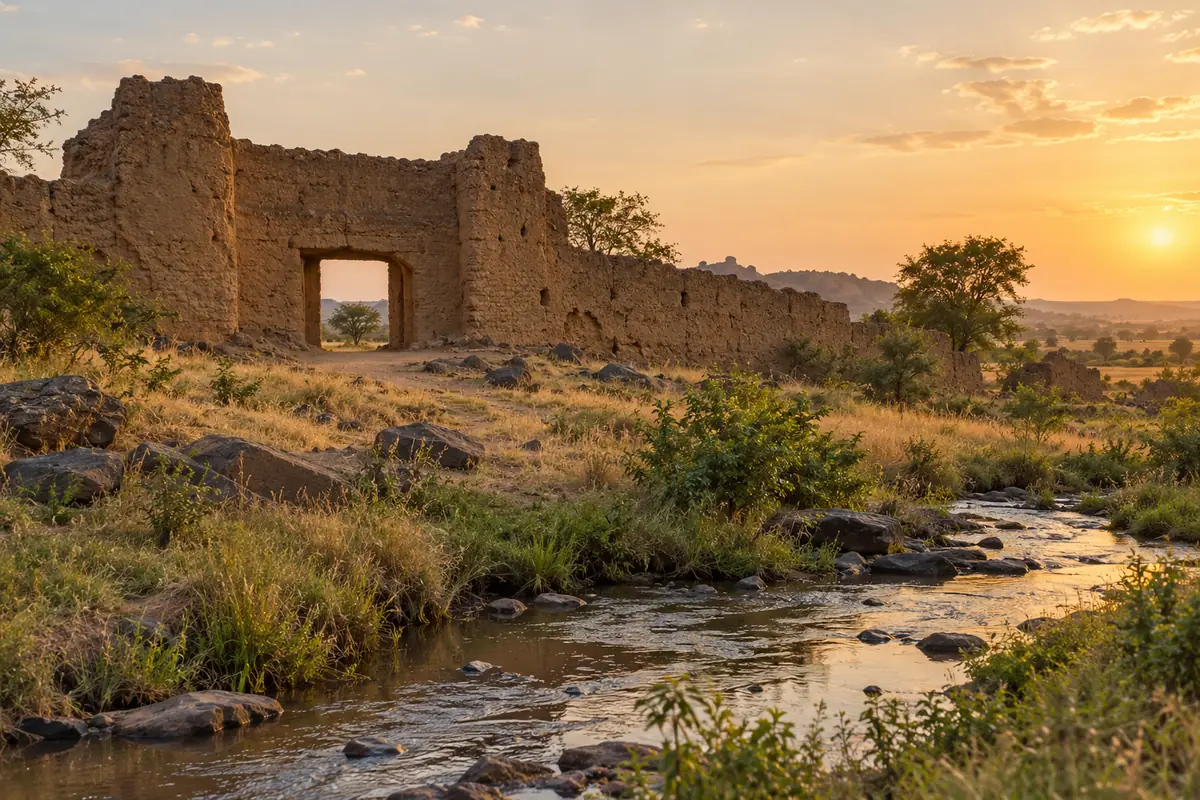
Image: Generated illustration — AI-generated for Naija Tales, reviewed for accuracy, Generated illustration, not a historical photo
The Alago walked out of a falling empire and built a walled town with nine gates, eight of them facing water. Centuries later they fought all the way to the Supreme Court to keep their throne their own.
Doma is a farming town in Nasarawa State, about 24 kilometres from Lafia, known today for its yams, its rice and a big Wednesday market that pulls traders from as far as Niger, Chad, Cameroon and Benin. Its people are the Alago, and they carry a long memory of how they got there. Their traditional council wrote it down in a book called Highlights on the History of Doma, and the journalist Matthew Eloyi summarised it in 2025.
The story starts with the break-up of Kwararafa, the great Jukun-led power of the Benue valley. The Alago say they were among the groups that walked away when it fell apart, and that back then they were called Idoma. Their leader was Andoma Osabonya Ogoshi. The road was long and winding. They went through Ogoja, in what is now Cross River State, then to Idah among the Igala, and then back north across the river Benue. Wikipedia adds stops at Ogyogo on the Benue and at a place called Oba'sidoma in what is now Keana.
At every stop, some people stayed behind and founded communities of their own. This is how the Alago explain their kinship with the Idoma of Otukpo in Benue State, who, the book says, still call the people of Doma Idoma Noku, the elder Idoma. Finally, the tradition says, around 1232, Osabonya stopped at the present site and founded the kingdom. He set up three ruling houses, Odorogya, Odogyo and Asibiri, which share the throne to this day. The town took its name from his title, Andoma.
There is a family quarrel in the story too. Osabonya's younger brother, Akyana Anyapa Adi, went hunting and found a salt spring. He chose to stay there and founded Keana, still famous for salt. The two towns later kept up an exchange: salt from Keana, and a royal cloth called Opa from Doma, as a sign of pardon and reconciliation. The tradition says the word Elagogo, born out of the brothers' falling-out, gave the people their new name, Alago, which slowly replaced Idoma. The date and the details are tradition. The bond between Doma and Keana is real.
Old Doma was a fortified town. Its wall was called Oba, and it had nine gates, each with its own name. The book lists them: Osumoku-Onah, Onarikpe, Orikitombwo, Osota, Okpagose, Okpa Godugushi, Okpago Kusupa, Okpago-Dorogya, and Akpada, the main gate on the road to Lafia.
Here is the clever part. Every gate except Akpada opened straight onto a stream. Doma sits among streams that, the book says, never dry up, with names like Arumangye, Obyegyegokpa, Odorogya and Okusupa. So when danger came, the people could shut themselves in and still reach water through their own gates. In a region where sieges and raids were a real threat, that was a serious advantage. Today the town has spread out over the old line and the gates are gone, but people still remember where they stood.
Doma was not only a fortress. Its rulers made friends. The book describes treaties with Zaria, Sokoto, Bida and Wukari, bringing military help in war and trade in peace. A Doma commander named Madakin Doma Abu is remembered in Zaria by the nickname Sara ka Gaji, a tribute to how hard he fought. Doma's woven garment, the Wandon Doma, became a prestige item across Hausaland. And in the late eighteenth century, the book says, an Andoma named Oboshi Oga took in a band of Kanuri refugees led by a man called Dunama and told them to go and settle in peace. Doma claims that the town they founded, Lafia, took its name from those words, though Lafia has its own version.
The kingdom kept its independence until 1901, when, according to Wikipedia, it was folded into the British Protectorate of Northern Nigeria. In 1903 the British gave the Andoma of the day, Attah Omaku, a fourth-class staff of office at Keffi, alongside the emirs of Lafia and Keffi and the Osana of Keana. In 1909 Doma was raised to third class.
That should have been the end of it, but Doma's modern history is a fight over respect. In 1932 a colonial reorganisation pushed the kingdom back down to fourth class. The book calls it an unjustified retrieval, and the Alago spent nearly forty years petitioning to get it back. In 1970 the military governor of Benue-Plateau, Joseph Gomwalk, restored the fourth-class staff. A chieftaincy panel then found that Doma had been third class since 1909. In 1980 the Plateau governor Solomon Lar raised the stool to second class, and on 1 June 1982 it became first class, with the staff presented that December.
Then came the hardest years. When Andoma Aliyu Addra Odeh Onawo died in June 1991, the rules said a college of seven kingmakers would choose his successor. In 1993 the Plateau government issued a new order that removed three of them, the Ogotu, the Akpoho and the Oleho. The remaining four chose Alhaji Yahaya Ari Doma, a retired police commissioner. The three removed kingmakers went to court, and while the case was still pending, the new Andoma was installed anyway, against a court injunction.
On 20 January 1995, Justice Matilda Ochoga of the Plateau High Court cancelled the appointment, struck down the 1993 order and put the three kingmakers back. The book says the town became bitterly divided, and accuses the losing side of using the police against opponents. The Court of Appeal upheld the ruling. Then, on 12 March 2001, the Supreme Court dismissed the final appeal. Justice M. E. Ogundare wrote that the appeal was completely devoid of merit, because the order behind the appointment was made while a court injunction was in force.
It took three more years, and the new Nasarawa State government, to finish it. On 4 September 2004 the full college of kingmakers met under official supervision. Five men stood, Yahaya Ari Doma among them. Ahmadu Aliyu Oga Onawo won four of the five votes and became the 43rd Andoma of Doma. The book calls those thirteen years the kingdom's dark age.