Custom · Generations to the present
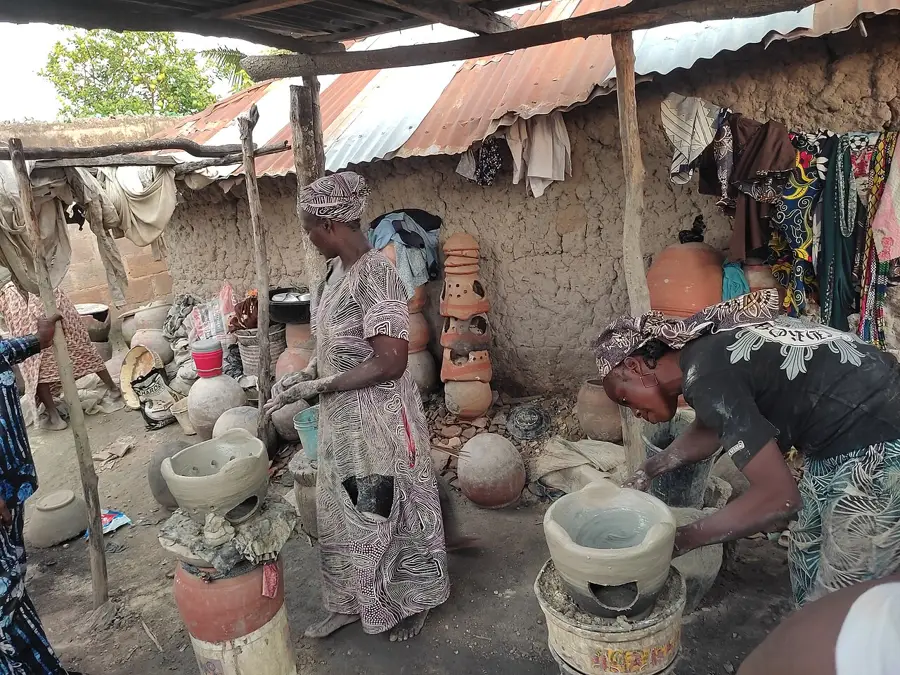
Image: .Potter at work at dada pottery, Ilorin, Kwara state.jpg — Sulyman Abdussamad, CC BY-SA 4.0 · source
At Dada in Ilorin, more than a hundred women make pots the way their mothers did, from clay dug out of other people's wells. Only daughters learn. The rain is their worst enemy.
Dada is a corner of Okelele in Ilorin East, just off the road to Sobi Specialist Hospital, and there's no signboard. Travel bloggers from Unravelling Nigeria needed a local man to lead them there. Inside, on about an acre of ground, you find heaps of clay, finished pots, broken pots, smoking fires, low sheds and children everywhere. More than a hundred women work here. Their leader, Alhaja Raliat Saka, told a Sunday Punch reporter where the clay comes from: wherever somebody in town is digging a well or a septic tank. The women collect the dug-out earth, soak it, dry it in the sun, then pound it fine and pick out the stones and grit, because a lump of grit can crack a pot in the fire. Then they add water until it becomes a firm paste. There's no wheel. A potter takes an old finished pot, turns it upside down and presses the soft clay over it to get the round shape, then smooths the outside by hand and with simple tools. The bloggers watched Saka put a bit of charcoal between the old pot and the new one so the fresh clay would come away cleanly. The pots dry, then a big batch is piled together, packed with sawdust and wood, and set alight. Afterwards they go back into the sun to harden. Saka said a good set takes about nine days from start to finish. Nothing goes to waste. Pots that break are pounded back into powder and turned into clay again, the photographer Folu Oyefeso wrote after his visit.
Ask one of the women a question and she'll point you to the leader. The Punch reporter found this, so did Oyefeso, and the bloggers waited to be received by Alhaja Raliat before anything happened. The group chooses her. The rule about who may learn is stricter still. "It is hereditary," Saka told Punch. "All our children partake in this trade. When they return from school, they join us." Girls come straight from the classroom and take up the work beside their mothers. Speaking to Daily Trust, when she was in her seventies, she called herself the sixth generation in the yard, and said that no outsider may learn it and no man either. "Our mother that passed down the craft did not teach any male, not even her own sons," she said. Where the craft came from is less settled. Saka has said that all pottery in Ilorin started at Dada, so anyone who makes pots elsewhere in the city must have learned it there. The historian Ann O'Hear, who interviewed Okelele potters in 1980, told a longer story. She thought Ilorin's pottery most likely came from Old Oyo, the great Yoruba capital to the north, whose old pots look a lot like Ilorin's. She also noted that the writer Sylvia Leith-Ross was told some potters came from Shao, a town just north of Ilorin. O'Hear found each family working for itself, with no guild at all. A mother could teach only her own daughters, and a woman who married into a potter family could learn its special kind of pot and pass it to her girls.
What comes out of the fires is a whole household. Saka listed some of it for the News Agency of Nigeria in 2024. There is the ishasun, the old cooking pot she says never lets food burn, along with jugs, food warmers, pots for boiling herbs, and the kolo, the clay money box with a slit in the top. There are big water pots that keep water cool where the light keeps going off, and large pots for indigo dye and for fermenting. Buyers come from Lagos, Abuja, Ijebu Ode and Kaduna, and Saka told Daily Trust that people drive in from Benin City, Onitsha and Warri. "We that own it don't value it," she said of Ilorin itself. The money has done real work. Women told Punch that pottery paid for their children's school, right up to university, and some had built houses or bought vehicles. In 2024 a potter named Mujidat Saheed told NAN the same thing about her own house and her children's schooling. The enemy is the weather. In the rainy season there isn't enough sun to dry the clay, and a downpour can ruin pots fresh from the fire. With no proper sheds, finished pots sit out in the rain and sun waiting for buyers. For years the women have asked for the same few things: a kiln, a covered warehouse and cheap loans. In October 2024 the Kwara government handed a site at Dada to a contractor, Clay of Lagos, to build a modern pottery with work sheds, training rooms and a showroom, and the contractor promised it in six months. In Daily Trust's later report, Saka was still asking for modern machines and soft loans.