Lost history · 1946–1949
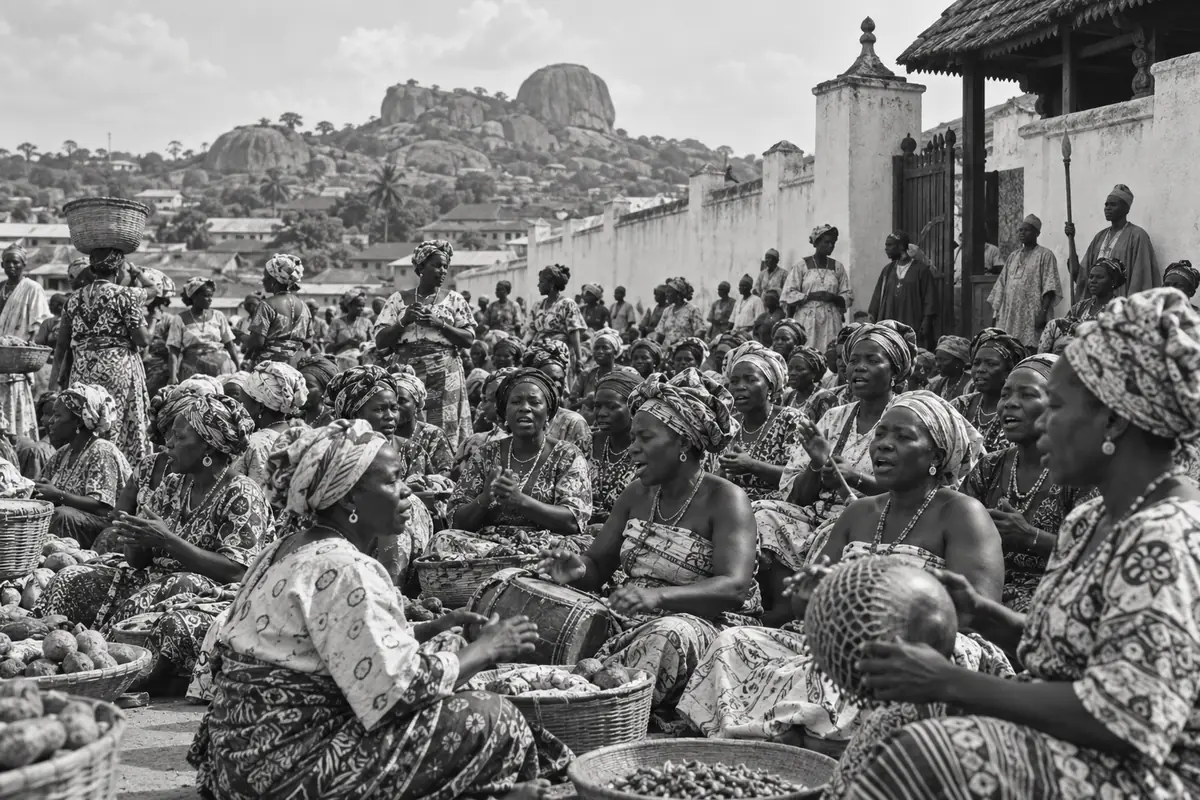
Image: Generated illustration — AI-generated for Naija Tales, reviewed for accuracy, Generated illustration, not a historical photo
Market women and a schoolteacher camped outside the Alake's palace, sang songs no king wanted to hear, and did not go home until the system changed.
To understand why thousands of women ended up sleeping outside a palace in Abeokuta, you have to go back to the First World War. The colonial government in southern Nigeria lived mostly on import duties, money from cloth, gin and gunpowder coming through the ports. The war squeezed that income, and officials in the Abeokuta province went looking for cash closer to home.
What they came up with was sanitation fines. You could be charged for leaving a pot of water out where mosquitoes might breed, or for not sweeping the ground in front of your house. Now think about who did those jobs in an Egba home. The women. So the fines fell almost entirely on them, and the summonses went to them, not their husbands. Eventually even the authorities admitted the fines were illegal, and they were scrapped. In their place, from January 1918, came a flat tax on women.
This was unusual. In most of the country women were not taxed separately from men. In Egbaland, and in Ijebu next door, they were, partly because Yoruba custom had always expected a woman to earn her own money in the market. The colonial system took that independence and turned it into a bill. And there was a catch that anyone could see: the council collecting the money, the Egba authority under the Alake, had no women in it at all. The old local councils had usually had at least one woman. The new arrangement had none. It was taxation without a single female voice in the room.
Six months after that tax began, the Adubi War broke out, a rising in which rail lines and telegraph wires south of Abeokuta were torn up. It was crushed. The tax on women stayed. For nearly thirty years the market women paid, grumbled and waited.
The person who changed things was a schoolteacher. Funmilayo Ransome-Kuti ran a school in Abeokuta and led a group of educated Christian women called the Abeokuta Ladies Club. She started hearing directly from market women about what the tax collectors were doing to them, and she listened. In 1946 the Ladies Club joined forces with the market women's associations and became something new, the Abeokuta Women's Union. Working beside her was her relative by marriage, Grace Eniola Soyinka, who many readers will know as the mother of Wole Soyinka.
That alliance is the heart of this story. Normally a headmistress and a woman selling pepper in the market moved in separate worlds. In the AWU they sat together, and they used every tool either group had. The educated side wrote. They sent petitions to the Alake again and again between August 1946 and May 1947, and they wrote to the press. They drew up real proposals: tax the foreign companies instead, spend money on roads, sanitation and schools, scrap the Sole Native Authority that let the Alake rule almost alone, and bring women into government.
The market side brought numbers and old methods. Yoruba women had long ways of shaming a ruler who had lost their respect, and they used them. When a delegation met the Alake in October 1946 and got nowhere, and the tax was then raised instead of cut, nearly a thousand women marched on the palace in the middle of that month. The police answered with tear gas and beatings. Many women simply refused to pay, and were fined or jailed for it. None of that broke the union. If anything, it made the women angrier and more organised.
In 1947 the union put its charges in writing, a document called the AWU's Grievances, setting out everything they held against the Alake and his authority. Then they went back to his compound, and this time more than ten thousand women came. They stayed for two days. And they sang. One of their songs, recorded by historians, told the Alake, Ademola II, that he had long used his manhood as a sign that he was their husband, and that the women would now turn that around and play husband over him. It is a crude song and it was meant to be. In Yoruba culture this kind of public ridicule from women was a serious weapon, and every man listening knew it.
Officials promised that the tax would be suspended and that the women would hear a decision within three days. Instead, more women were assaulted and more were arrested. So on 8 December the women came back, again more than ten thousand strong, and camped outside the palace. They told the authorities they would not leave until every arrested woman was freed. They held their ground until the 10th, when the prisoners walked out, and only then did they go home.
The petitions kept coming, and the pressure on the Alake became impossible to carry. On 3 January 1949 he abdicated. The Sole Native Authority was reformed, and four women took seats in the new council. The union celebrated with a pamphlet titled The Fall of a Ruler or The Freedom of Egbaland, which opened with lines from the American Declaration of Independence. Not everything held. The Alake later came back to his throne, and the relief from the flat tax did not last. But the women had shown that a ruler propped up by a colonial government could be brought down from the market square, years before Nigeria itself was free.