Legend · c.900–1400 AD
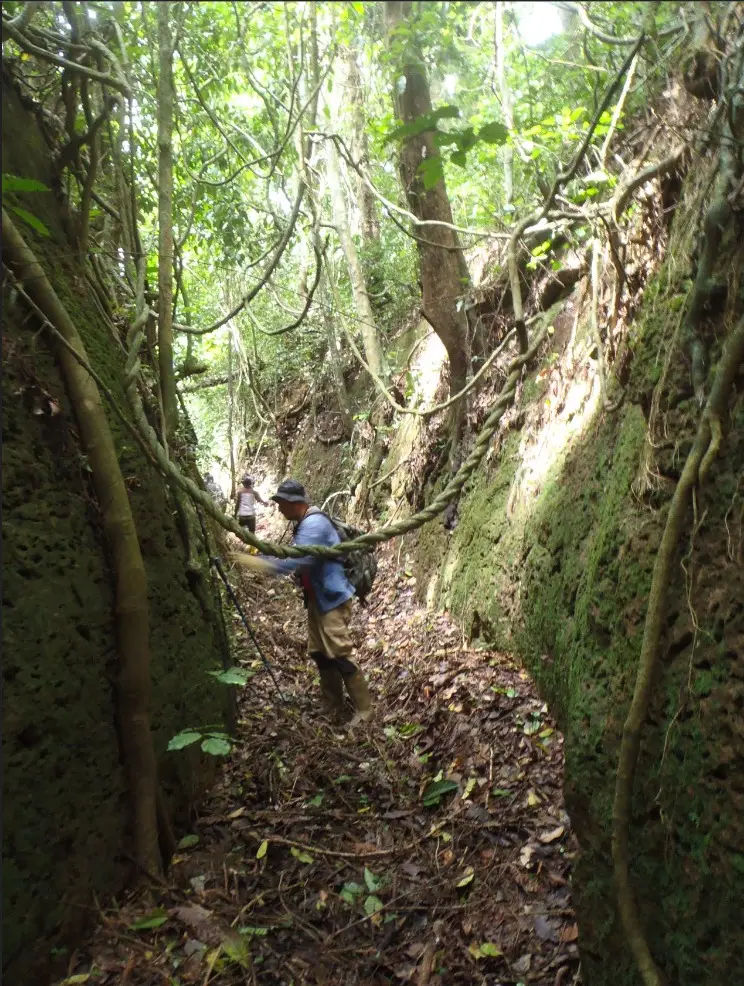
Image: Inside the Sungbo Eredo.jpg — Unknown author, CC0 · source
Hidden in the Ijebu forest is a ditch longer than the road from Lagos to Ibadan. Who dug it, and why?
Picture a ditch so deep that trees grow inside it and their tops do not reach the rim. Its red earth walls rise up to twenty metres on each side. Now imagine that ditch running in a huge loop through the forest for more than one hundred and sixty kilometres. That is Sungbo's Eredo, near Ijebu-Ode in Ogun State. Eredo simply means a ditch with a bank.
It is one of the largest earthworks ever made in Africa. People dug it by hand in hard laterite soil, without machines, a long time ago.
Local people have a story about who made it. They say a rich widow named Bilikisu Sungbo, who had no children, ordered the ditch to be dug. Some say she wanted it as her lasting gift, since she had no family to remember her. Her grave is said to be at Oke-Eiri, and to this day people visit it, some of them Muslims and Christians on pilgrimage.
Some people go further and say Bilikisu was the Queen of Sheba, the queen in the Bible and the Quran. That is a big claim. The British archaeologist Patrick Darling, who studied the Eredo for years, said the idea could not be thrown out completely. But the dates make it very hard to believe, because Sheba lived about three thousand years ago.
So when was it dug? Darling thought around the 10th or 11th century. Newer work points later, to around the late 1300s or early 1400s. In recent years a team led by Gérard Chouin from William & Mary in the United States used a laser scanner from the air, called LiDAR, to map a thousand square kilometres of forest over five years. They found the ditch is about 170 kilometres long.
Most experts now think the Eredo marked out the edge of an early Ijebu kingdom, a way of saying: this land is ours. It may also have slowed down attackers.
The Eredo is on Nigeria's tentative list for UNESCO World Heritage, but most Nigerians have never heard of it. Bush and farms creep over parts of it. It is a reminder that people in this land were organising big building projects long before anyone from Europe arrived.
Visitors who go into the Eredo say it feels like walking in a green tunnel. Ferns hang from the walls, roots twist out of the red earth, and the air is cool and damp even on a hot day. The photo on this page was taken inside it. Imagine the thousands of people who must have dug it, basket by basket, over many years. Someone had to plan it, feed the workers and keep the work going. That tells us there was a strong, organised kingdom here, long before most history books begin their story of Nigeria.