People · 1872–1943
Image: Generated illustration — AI-generated for Naija Tales, reviewed for accuracy, Generated illustration, not a historical photo
Her family refused her a dowry. She went on to command 20,000 gallons of palm oil, sit in a colonial court and own twenty-four houses in Onitsha.
Okwei was born in 1872 in Ossomari, a town on the Niger in today's Anambra State. She came from royal stock on both sides. Her father, Prince Osuna Afubeho Nzedegwu, was a son of the Ossomari king Atanmaya Nzedegwu I. Her mother was a granddaughter of Obi Ossai, a king of Aboh. So by birth she was somebody. But what made her famous was not her birth. It was what she did with her hands and her head.
When she was nine, her mother sent her away to live with an aunt among the Igala, upriver. It was a common enough thing, sending a child to learn from a relative, and Okwei learned trade. She sold fruit, yams and poultry, and she learned how a deal is made and kept. At fifteen her father died and she went to live with her mother at Atani, another town on the river.
Then she did something her family did not like at all. In 1889 she married Joseph Allagoa, a trader from Brass in the Niger Delta. Her relatives disapproved so strongly that they gave her no dowry. The marriage produced a son, also named Joseph, and ended in divorce the very next year. Allagoa did not help support the boy. So the young mother did the thing she knew how to do. She went on the river.
She travelled up and down the Niger selling cloth, pots and lamps, trading them for food, and selling that food to Europeans. In 1895 she married again, to Opene of Aboh, and again her family objected, saying his background was not good enough for a woman of her rank. She married him anyway. They had a second son, Peter. And it helped, perhaps, that Opene's mother, Okwuenu Ezeiwene, was one of the wealthiest women of her day.
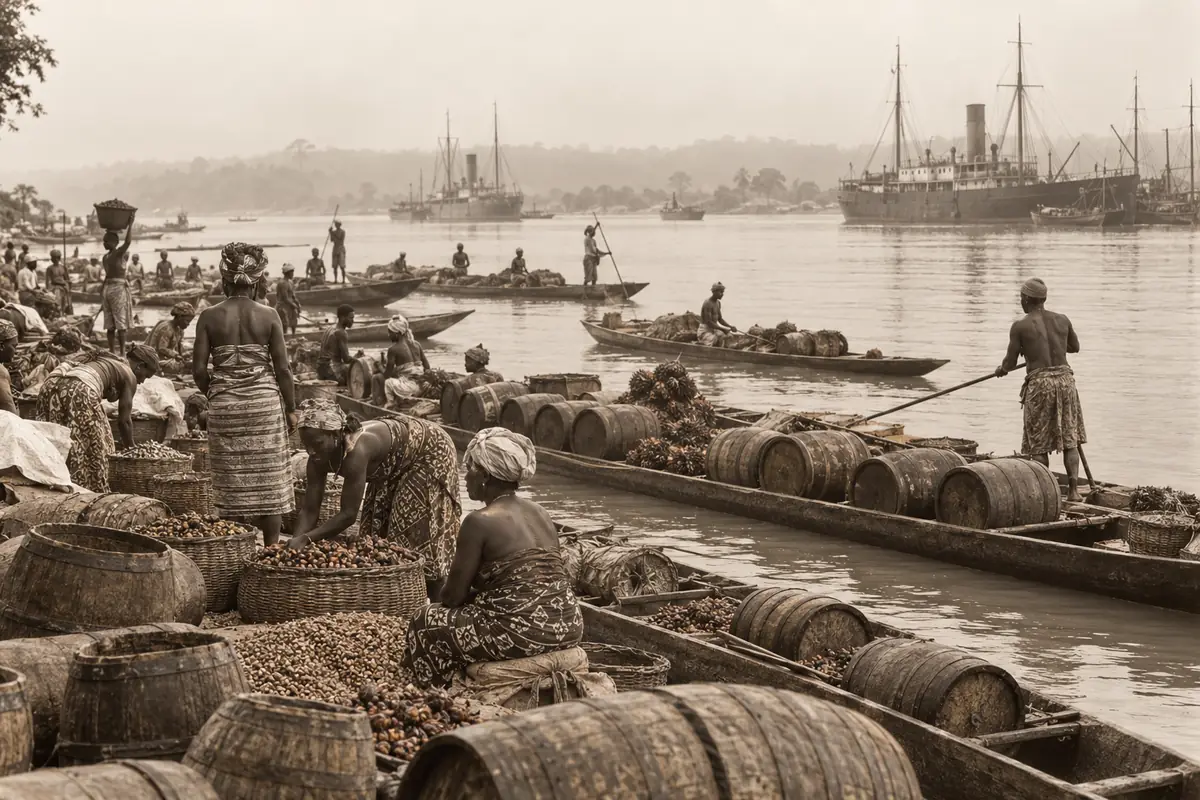
This was the moment of the palm oil boom, when British firms were hungry for the oil and kernels of the Niger country. Okwei saw where the money was going and attached herself to it. She worked with the Nigerian Company, selling them palm oil and taking European goods in return, which she then sold on in local markets.
The colonial trade ran on credit, and credit is about trust. At the height of her business Okwei was given 400 tickets, worth 20,000 gallons of oil, to sell. That number tells you everything. A European company was willing to trust one Igbo woman with that much produce, because she was known to deliver a profit. Later, in the 1920s, she moved up from palm oil into luxury goods such as gunpowder, ivory and coral beads.
There is a part of her business that we should not skip, because it is in the record and it matters. Okwei took in young girls, often the pawned children of people in debt, and raised them. She then placed them as mistresses and wives with influential traders coming into the country. Her rule was that the women came back to her when the men left Nigeria, and whatever property they had gained went back to her too. It was a way of building alliances and wealth. It was also a trade in other people's lives, and it is part of who she was.
Her standing also reached into colonial government. The British usually gave their warrants, the papers that let people sit in the Native Courts, only to men. Okwei was one of very few women to get one, and she sat in the Onitsha Native Court from 1912 until the 1930s.
Among the Igbo of the Niger towns there was an old system in which power was shared between men and women. The king had his council, and the women had theirs, led by a female monarch called the Omu. The Omu ruled over women's affairs, settled their disputes and managed the market. She had her own palace and her own councillors, and she advised the king.
In August 1935 Okwei was crowned Omu of Ossomari. Normally the Omu had to live in the town, but she was allowed two homes, one in Ossomari and one in Onitsha, where she spoke for her hometown in government business. She also became chairwoman of the Council of Mothers, the women's body that oversaw retail trade.
She cared a great deal about schooling for her sons. Joseph, her first boy, became a district interpreter and later a court registrar, and in 1935 he became the Amanyanabo of Nembe, succeeding his father. Peter worked as a storekeeper for the Nigerian Company, which of course helped his mother's trade.
When Okwei died in Onitsha in 1943 she left £5,000 in the bank and twenty-four houses in the city. A statue stands at her grave. She is remembered as the last Omu of Ossomari, and still the most powerful one. Not long after her time, the British took over the job the Council of Mothers had done in supervising the markets, and that whole world of women's authority began to fade.