Lost history · 1900-1947
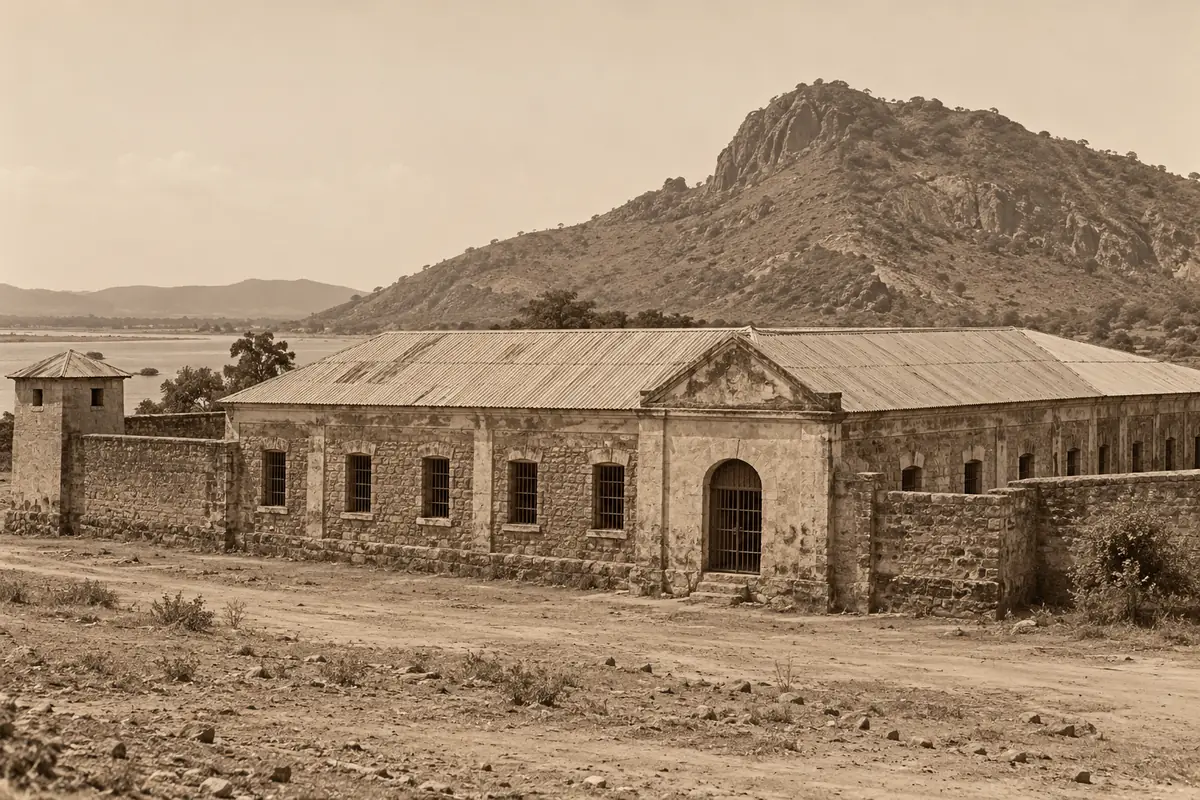
Image: Generated illustration — AI-generated for Naija Tales, reviewed for accuracy, Generated illustration, not a historical photo
For twenty years, Northern Nigeria's only asylum was a converted jail in Lokoja. The colonial records show what it was really for. Almost nobody was ever discharged, and almost everyone was put to work.
In the old Kabba Province, the area that is now Kogi State, mental illness was a family matter long before the British came. People understood it through natural, preternatural and spiritual causes, and families looked after their own. They used their own knowledge of herbs, and when that was not enough they went to specialists. Among the Igala there were professional herbalists called obochi, and healers such as Wada Enoh of Umomi were known far and wide for treating mental illness. If a sick person had no family, the community chose someone, or took turns, to care for them. Locking people away was not the usual answer.
Colonial rule changed that. The British made Lokoja, where the Niger meets the Benue, the capital of the province, and Lokoja had a prison. That prison held people the British wanted out of the way: criminals, people who resisted colonial rule, and people judged to be mentally ill. And it gave the government something it badly wanted, a captive workforce.
The North had no asylum of its own until the late 1920s. In the meantime, the mentally ill stayed in prisons, and they worked.
The records are blunt. At Ankpa prison, people classed as lunatics grew yams and maize beside the other prisoners. At the Agbaja prison farm everything went into cotton, and the mentally ill laboured in the fields. In 1926 the Lokoja convict prison held 32 people classed as lunatics, ten of them not accused of any crime at all. Across the North's prisons that year there were 170. Only Zaria held more than Kabba. In 1925 a medical officer inspecting the prisoners found they were fed nothing but dry roasted yam, twice a day, while being made to do hard manual work.
By the mid-1920s officials were looking for a site for a northern asylum. The prisons director wanted Zungeru. The lieutenant governor and the doctors said no, partly because there would be nothing for the patients to do there. Lokoja won because the patients could be kept busy with cotton work. In the end the whole Lokoja prison was handed over. When Lieutenant Governor Herbert Richmond Palmer asked in September 1926 how many mentally ill people were there, the answer was 30: 27 men and 3 women, nine counted as criminals and 21 not.
The loudest objections did not come from anyone worried about the patients. They came from the Europeans who lived nearby. In January 1927 the station magistrate, G. Mille Clifford, wrote that the howls of the 32 lunatics already in the prison kept him awake, and that on Lokoja's hot, breathless nights the station should not have to listen to the screeches of a large asylum. The Resident, J. C. Sciortino, agreed, warning that life in the station would become a nightmare.
The governor overruled them all and called it a purely local problem. The prison was declared an asylum. A map of it from 1928 shows almost nothing but cells, with a kitchen, a guard room, a warder's office and one pavilion. The prison hospital was not given to the patients. It was turned into a new prison.
What the asylum did best was work. Patients were sent out to clear European stations in the rainy season. Lokoja was full of mosquitoes and sandflies, and the cheapest way to fight malaria was to fill, level and drain every pit where water collected. The patients did much of that, filling borrow pits with earth taken from the old city wall.
Inside, they ginned and spun cotton. A senior health officer who inspected the place in January 1941 wrote that, apart from the few who had to be kept under restraint, all the lunatics were usefully employed in cotton ginning and spinning, producing excellent heavy cloth for uniforms. That August he noted that the women spun cotton which men then wove, and that all the clothing for the prison and the asylum was made there.
The people chosen for this work were not the dangerous ones. They were the harmless, often people with intellectual disabilities, who could not resist. And they rarely left. A 1936 memo said discharges were practically nil, and predicted the patients would soon outnumber the prisoners. They did. By 1941 the prison held 173 people, 101 of them mentally ill. By January 1947 there were 120 patients, with prisoners acting as their attendants because there were no trained staff.
Inspectors kept saying the building was unfit. In 1937 a medical officer protested a court's decision to send a man there, saying good nursing was impossible in a government prison. In 1938 an inspection found the patients living under the worst possible conditions. The government's eventual answer, in 1947, was not to move the patients. It was to build new houses for the Europeans, far enough from the noise, and to promise the patients beds in a new hospital at Abeokuta in about two years' time. The North's first psychiatric clinic finally opened at the General Hospital in Kaduna in 1954.