Lost history · 1920s to 1970s
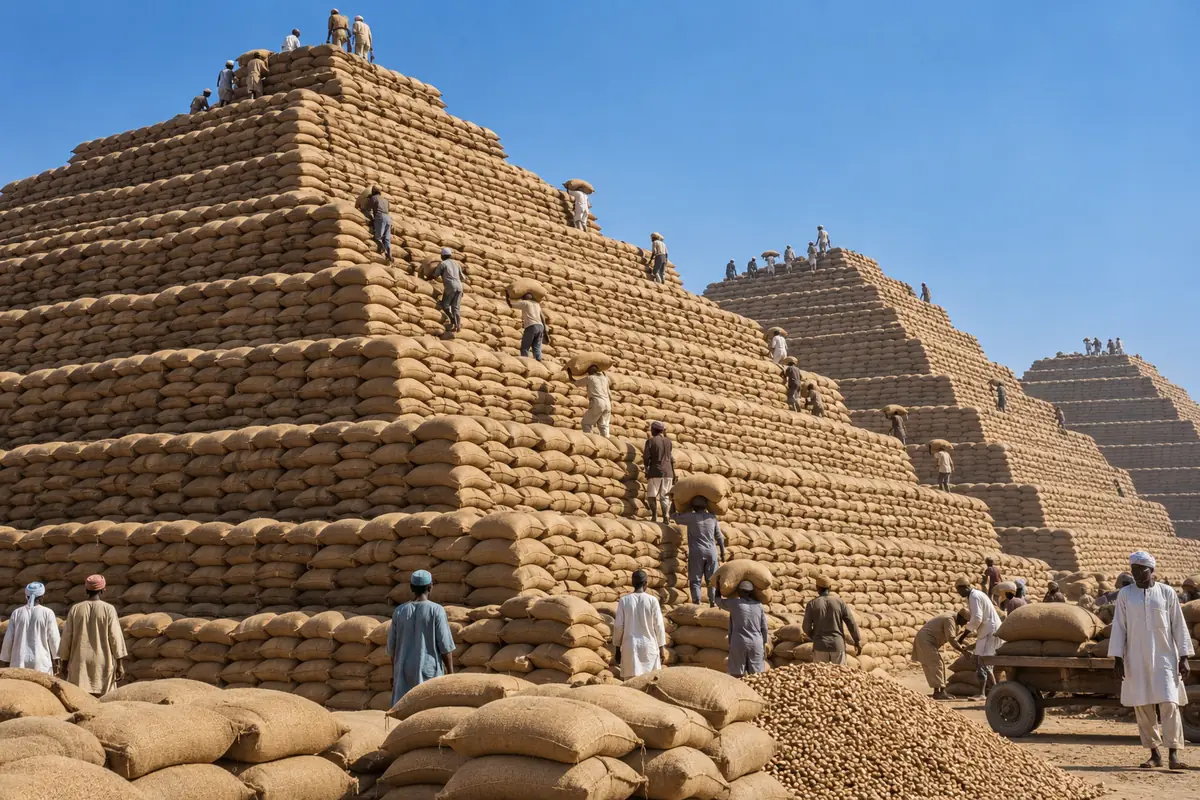
Image: Generated illustration — AI-generated for Naija Tales, reviewed for accuracy, Generated illustration, not a historical photo
Sacks of groundnuts were once stacked into pyramids so tall they appeared on a Nigerian postage stamp. Today one of their old sites in Kano is a football pitch.
If you grew up in Nigeria, someone older has probably told you about the groundnut pyramids. They usually say it with a little sigh. It sounds like an exaggeration, the kind of thing people say about the good old days. It is not. They were real, and for a while they were one of the most famous sights in the country.
A groundnut pyramid was exactly what it sounds like. Sacks of shelled groundnuts were stacked layer on layer, each row a little narrower than the one below, until the pile rose into a pyramid. They were used as temporary storage before the nuts were moved by train to the coast for export. One pyramid could be built from as many as 15,000 full bags.
There is an old photograph from Kano in 1965 of labourers climbing one of these stacks, carrying sacks up the side. It gives you the scale. A man on top looks tiny. Every one of those sacks was filled by farmers somewhere in the North, carried to a buying point, weighed and then lifted into place by hand.
They were not only in Kano city. Reports list pyramid sites at Kofar Mazugal, Brigade, Bebeji, Malam Madori and Dawakin Kudu, among others. Across the groundnut belt, these stacks rose wherever the crop was gathered. They became a tourist attraction in their own right, and the government put one on a postage stamp. For a young country, they were a picture of wealth you could see from a distance.
The usual story says the pyramids were the idea of Alhassan Dantata, the great groundnut trader and great-grandfather of Aliko Dangote. That is how it is commonly told, though it is better to treat it as tradition than as a proven fact. What is well documented is that Dantata was at the centre of the trade.
He came to Kano around 1919, and within a few years he was one of its most successful businessmen. He supplied most of the groundnuts bought by the Niger Company, which later became part of the United Africa Company. His company kept its groundnuts at a facility in Kofar Nassarawa, and the bags there were stacked into pyramid shapes before they were shipped out.
It made practical sense. A pyramid is stable. It does not need walls or a roof. It lets a lot of sacks sit in a small yard, and anyone looking at it can roughly tell how much is there. And it happens to look magnificent, which did no harm to a trader's reputation.
The scale of the trade explains the size of the stacks. By the 1940s Dantata alone was buying and selling about 20,000 tons of groundnuts a year. Nigeria became one of the world's leading producers, and Kano Province grew almost half of the country's crop. The pyramids were what that number looked like when you stood in front of it.
The railway made it all possible. Once the trains ran, a trader could gather a mountain of sacks in a Kano yard and send it to Lagos in bulk. Dantata himself used the railway from 1926 to trade cattle and kola with the south. The pyramids were, in a sense, waiting rooms for the train, the place where a whole season's harvest sat in the sun until the wagons came.
Then they disappeared. Through the 1960s and 1970s, as Nigeria's economy turned from agriculture to oil, groundnut production fell. By the 1970s and 1980s the pyramids were gone, and the land where they stood was taken over by other things. In many places, buildings went up.
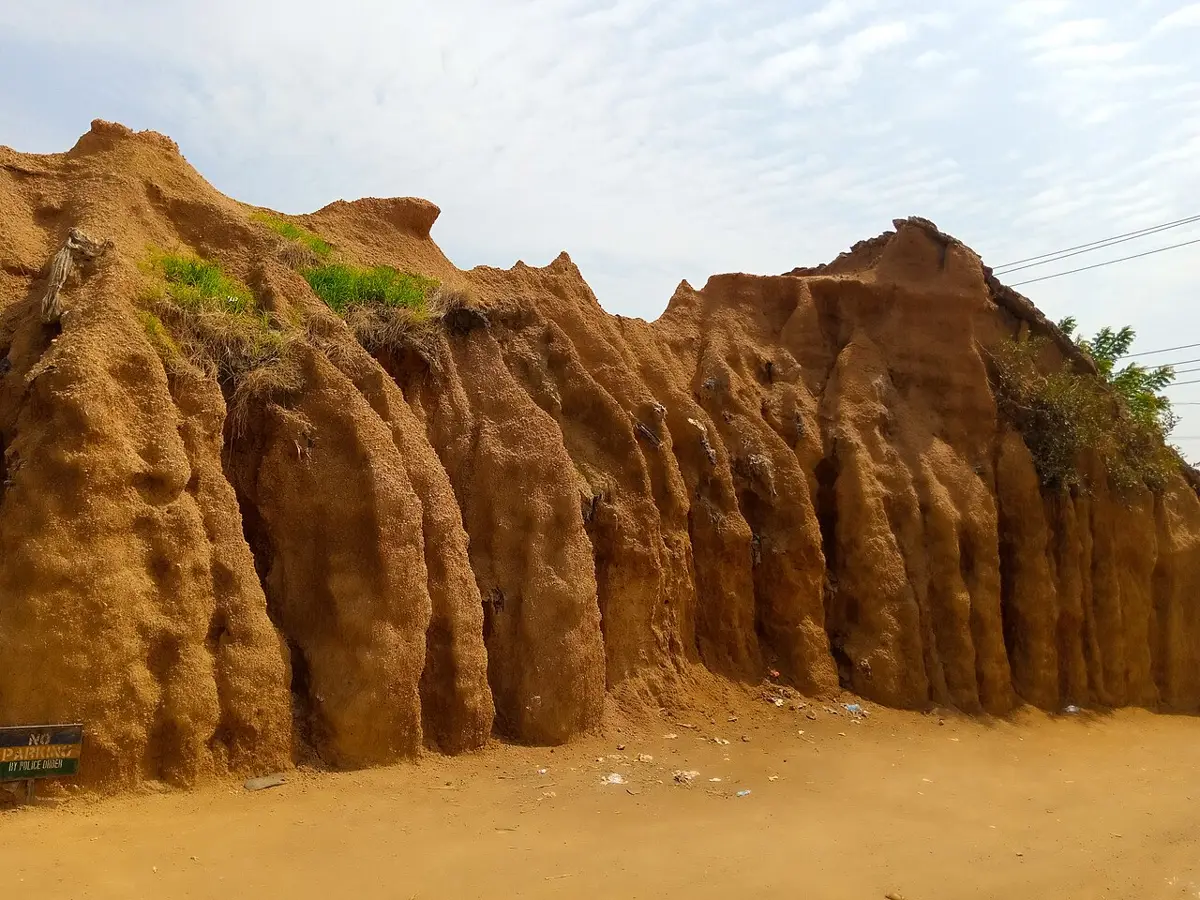
At one old site in Kano, a Daily Trust journalist went back to look. What he found was a football field. Where tens of thousands of sacks once stood, boys now kick a ball. The site at Kofar Mazugal in Dala has also been used as a campaign ground. There is nothing there to tell you what it used to be.
Governments have promised to bring them back more than once. On 24 February 2014, the then agriculture minister, Akinwumi Adesina, launched a groundnut value chain project with the research institute ICRISAT. One of its stated goals was to raise production enough to rebuild the pyramids. In March 2015 President Goodluck Jonathan repeated the promise during a visit to Kano. The pyramids have not returned.
That is why people talk about them with a sigh. The pyramids were not monuments in the usual sense. Nobody built them to last. They were piles of a crop waiting for a train. But they stood for something that was real, a North whose farmers fed a big part of the world's groundnut market. The football field is a reminder of how fast that world went, and how little of it was left standing.