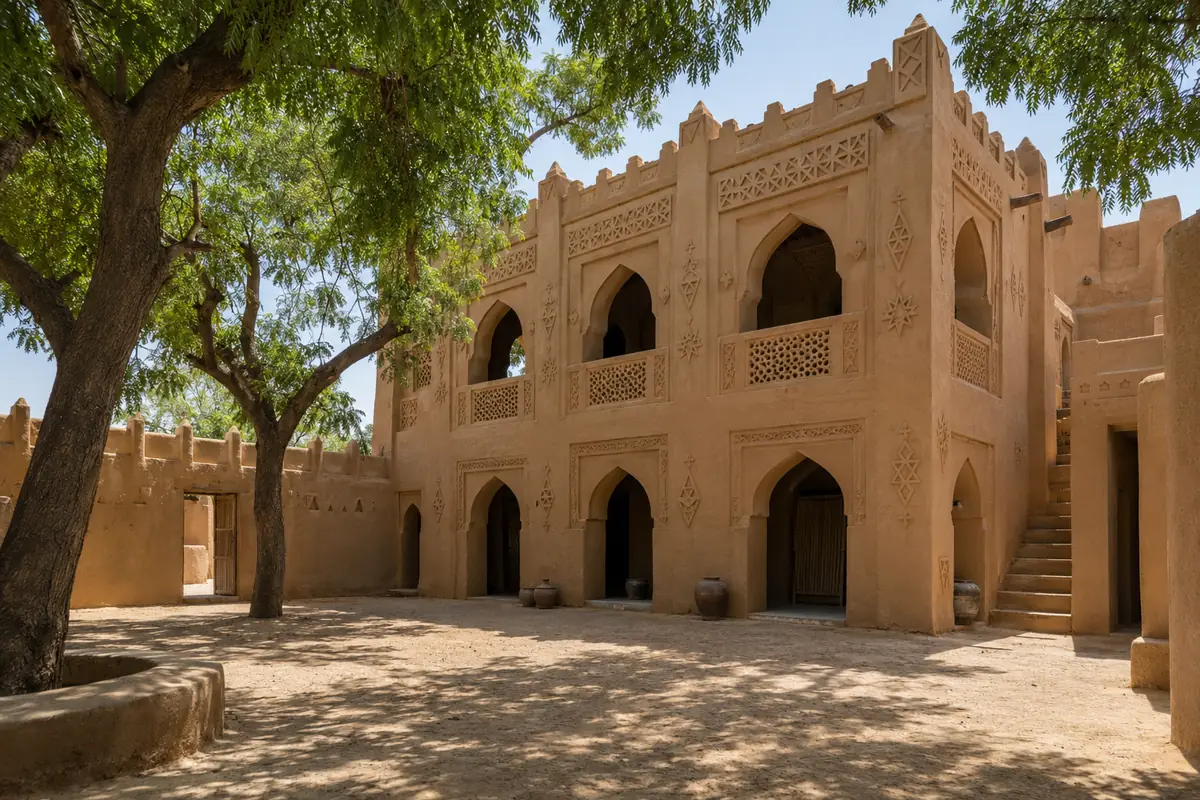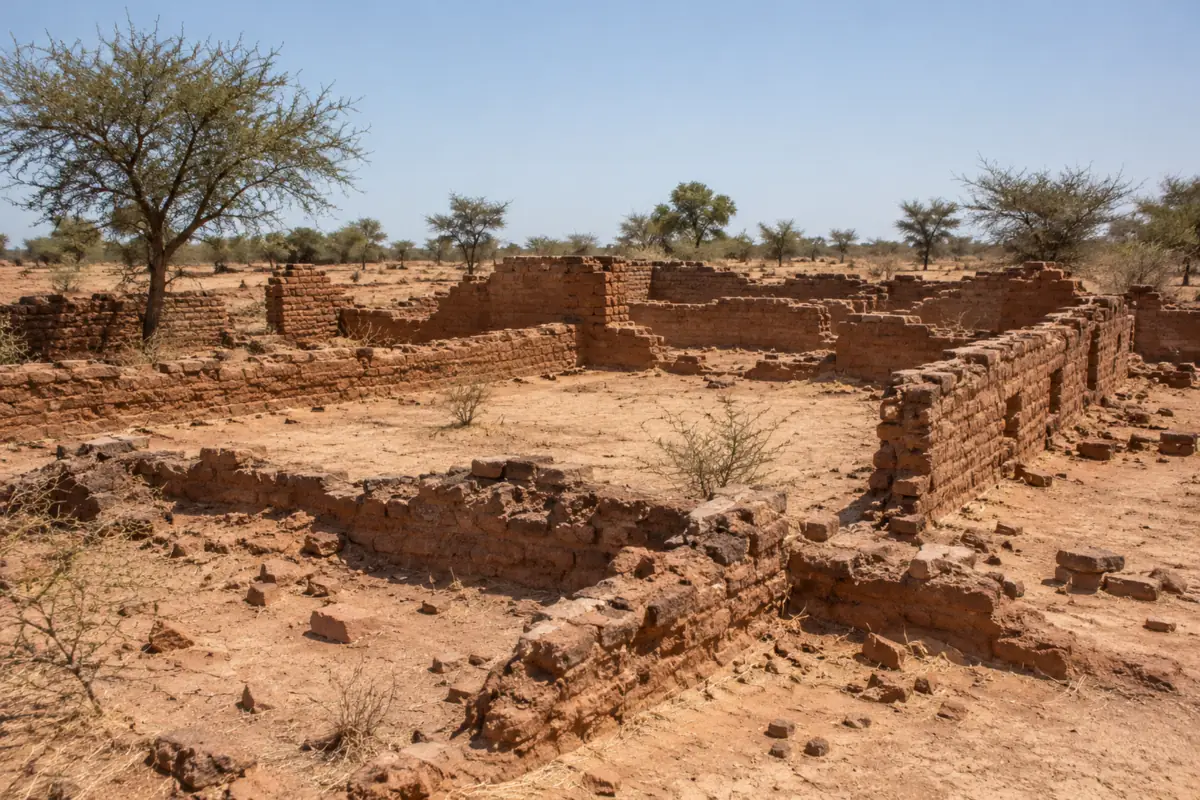
Lost history · 17th-18th century (radiocarbon)
Image: Generated illustration — AI-generated for Naija Tales, reviewed for accuracy, Generated illustration, not a historical photo
Outside Monguno lie the remains of a walled compound built of fired brick, a material once kept for kings. The village beside it has forgotten who built it.
If you grew up in a mud-brick town in the north, you know how houses are made there. Earth is mixed with water and straw, shaped, dried in the sun and built up into walls. That was how almost everyone built in the old Kanem-Borno empire too, the great Kanuri state around Lake Chad that lasted for about a thousand years. Mud is cheap, cool and easy to repair. But it does not last forever, and when a town is abandoned its walls slowly melt back into the ground.
Fired brick is a different thing. You have to dig clay, mould it, and then burn it in a kiln with a lot of fuel, which is scarce on the dry plains of Borno. In this region that kind of effort was not spent on ordinary homes. Across the Islamic world, and in the Lake Chad basin in particular, burnt brick went into tombs, palaces and mosques. Archaeologists working west of Lake Chad have found it again and again at places tied to the Sayfawa royal court, the old ruling dynasty of Borno. The great walled capital of Birni Gazargamo, near Geidam in today's Yobe State, used it. So did the so-called Queen-Mother site at Gambaru, and the palace of the Mai of Machina, which an archaeologist told Kanem Press was the only burnt-brick building still used by a traditional ruler into the 1990s.
So when Kanuri speakers find a field of broken red brick, they have a name ready for it: gòrú kìmé, the red wall. Hausa speakers say jan bulo. It is a general name for brick sites, and one of those sites carries it as its own. Four kilometres west of Monguno, on sandy ground just south of the main road from Maiduguri, lies Garu Kime, also written Guru Kim. Facing it across the road is a modern Kanuri village with exactly the same name. Kanem Press called it the southernmost burnt-brick site west of Lake Chad, about twenty kilometres from where the lake's shore was in the 1970s.
The first archaeologist to describe the place properly was Graham Connah, the British scholar famous for his work on Borno and on ancient Benin. What he saw was not dramatic. There was no standing wall, no gate. There was a square enclosure about 75 metres long and 53 metres wide, marked by a raised bank about a metre high, its surface littered with broken red brick. More brick lay scattered inside, especially on one slightly raised patch.
About 75 metres from the north-west corner of the enclosure, he found a roughly round mound about 25 metres across and a metre and a half high, also scattered with brick. Around the site, especially to the north-east and east, lay grey-stained sand and at least three low mounds of the kind left by old settlements. That was where the ordinary people had lived. From the surface Connah collected bits of grinding stones, iron slag, a spindle whorl made of burnt clay, and pieces of decorated pottery, mostly jars and pot lids. Spinning, grinding, smelting: the leftovers of everyday life around a walled compound.
The pottery gave the first clue to age. It looked like pottery from a late phase at Birni Gazargamo, the old capital, which was abandoned in the early 1800s. The villagers of the 1970s added their own clue. They told Connah the site was older than Kukawa, the Borno capital that rose in the nineteenth century. And they told him what each part had been. The square, they said, was the compound of the Mai, the king. The round mound was a mosque. The rest of the town had stood all around.
The colonial official and historian H. R. Palmer had earlier wondered whether the site might go back to the 1400s, when the royal court moved west from Kanem into Borno. That would have made it a very important place. But when a team of researchers came back to survey and dig for three days, and published their results in the African Archaeological Review in 2009, radiocarbon dating told a different story. Garu Kime belonged to the seventeenth or eighteenth century.
That later date turned out to be interesting in its own right. The 2009 authors noted that it falls in the period when several other places in Borno, such as Waro, Lergam, Gaskeru and Kulumfardu, are thought to have been founded. They suggested this might reflect a time when brick buildings were put up on purpose out at the edges of the kingdom's heartland. A red wall in the provinces, in other words, may have been a statement: the court is here too.
The most striking finding, though, was not about bricks. When the researchers talked informally with five people from the modern village of Guru Kim in early 2008, none of them knew anything about the brick site beside their homes. The district head in Monguno knew almost nothing either. Within a generation of Connah's visit, the story of the Mai's compound and the mosque had faded.
When the journalist Tabitha Ishaya went back for Kanem Press in 2022, she interviewed seven more people aged between 33 and 65, some of them relatives of the village head. Their answer was the same each time. The site, they said, was made by their ancestors. Nothing more. She was writing in a state that had lived through more than a decade of Boko Haram violence, and Monguno itself had hosted one of the biggest camps for displaced people in Borno. Her complaint was that the old heart of Kanem-Borno has very few protected historical sites, and that places like Garu Kime have never been fully dug.
So the honest summary is short. Someone with power built a brick compound and a second brick structure beside it, near Monguno, three or four hundred years ago, with a busy settlement around them. Tradition once called it a king's house and a mosque. We still do not know what it really was, and the people who might have remembered no longer do.