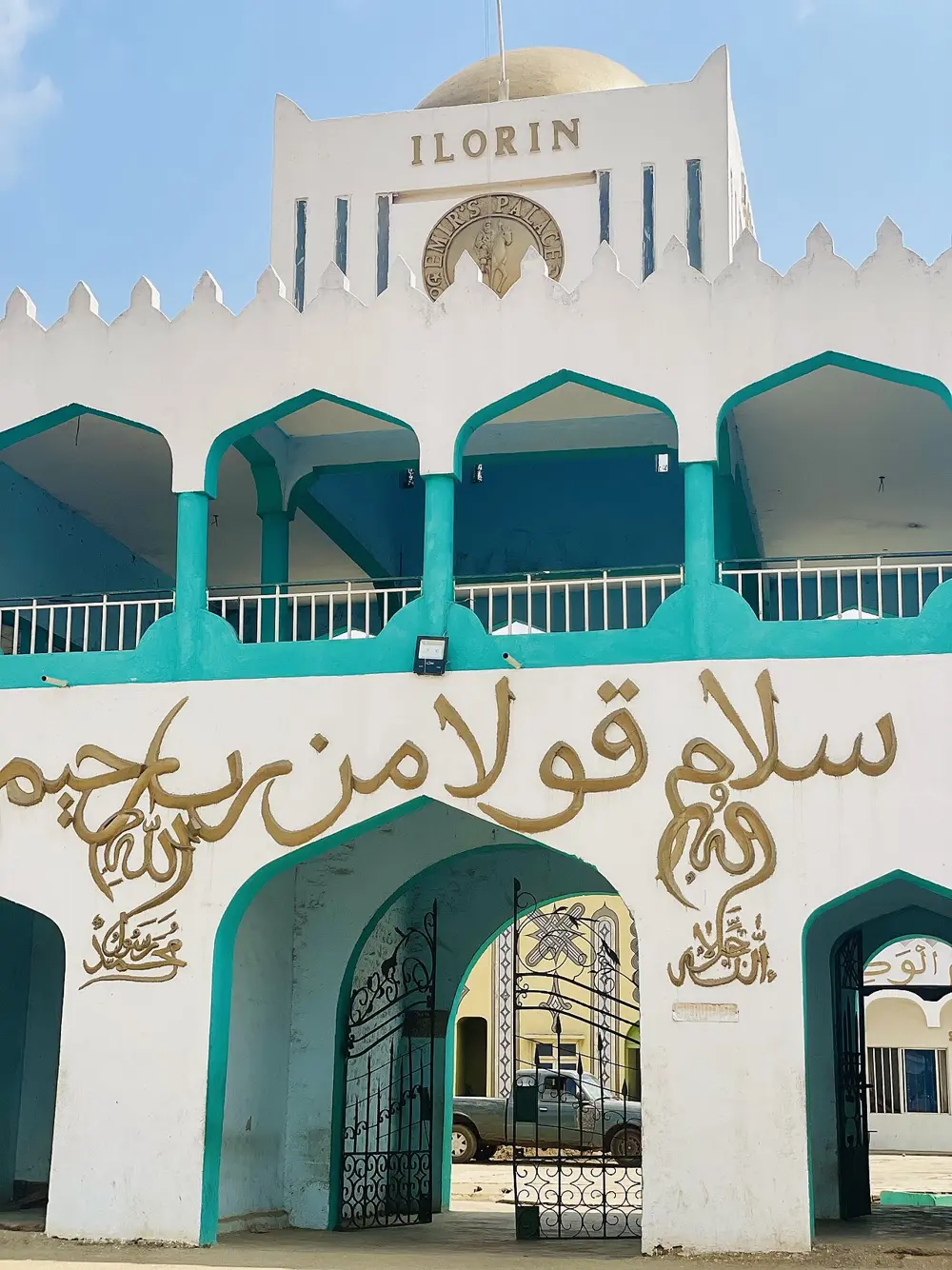
People · c. 1796-1824
Image: Emir Palace Ilorin Entrance.jpg — MubarakahSidiq, CC0 · source
An Oyo commander built his independence with Muslim allies, then died as their struggle for Ilorin turned against him.
In the 1790s the most feared soldier in the Oyo Empire was a man called Afonja. He held the title Aare-Ona-Kakanfo, the field marshal of the empire, the general who led its armies in the field. Where he came from is less clear. Samuel Johnson, the Yoruba historian, gives more than one version. In one he is an Ilorin man with royal blood through his mother. In another his mother was a slave born in the palace, and he grew up among the Alaafin's children at Oyo-Ile. The king of the time, Alaafin Aole, once called him his own kith and kin.
That did not make them friends. Aole was afraid of him, and he set a trap. A new Alaafin was expected to name an enemy town for his army to attack, and Aole pointed Afonja at Iwere, a town said to be impossible to take. The idea was simple. Afonja would fail, and an Oyo general who failed was expected to kill himself.
Someone told Afonja about the plot before the army got there. He turned around. Along with other angry chiefs, he marched back on the capital, killed the king's loyal party, and surrounded Oyo-Ile. In the end Aole was forced to take his own life. Wikipedia's account adds that the chiefs sent him an empty covered calabash, the old sign that a king had been rejected.
That was about 1796. Afonja then settled at Ilorin, a small place on the northern edge of the empire, and refused to recognise the next kings Oyo put on the throne. Many history books say he rebelled in 1817. The Ilorin historian Ismail Salihu, writing in 2024, argues the real break came around 1797, and that for the next twenty years nobody in Oyo-Ile was strong enough to do anything about it.
Someone did try once. Ojo Agunbambaru, the son of a powerful Oyo chief who had been killed years before, came back from exile with a Bariba army to punish the rebels. He nearly won. Then, in Johnson's telling, the Onikoyi, one of his allies and secretly Afonja's friend, walked off the field with his men, and the attack fell apart. Ilorin's own accounts tell it differently. They give the credit to the prayers of a Fulani cleric named Alimi and the fighters who came with him.
After that win, people started pouring into Ilorin. Many were Hausa and other northerners who had been slaves in Oyo, and a lot of them were trained horsemen and grooms who had worked in the Oyo cavalry. Afonja promised them freedom, a place in his army and a share of whatever they captured. They became his Jama'a, his militia. Close by, at Oke-Suna, a Muslim chief and scholar named Solagberu led his own community, and he was Afonja's friend too. With them, Ilorin grew from a small town into a real power.
Around 1817 Afonja invited Alimi to come and live in Ilorin. Alimi made prayers and charms for the warriors. According to Johnson, he also tried to rein in the Jama'a, who had begun to raid and rob with no one stopping them. People warned Afonja about them, and he brushed it off.
Then the balance shifted. Alimi's sons, Abdul-Salami and Shitta, came down from the north, and Fulani families driven out of Nupeland came to shelter under Alimi. When Alimi died around 1823, the Muslims of Ilorin chose Abdul-Salami as their emir. Afonja could see that the town he had built was slipping out of his hands.
Around 1824 it came to a fight. What happened next is told in so many ways that Salihu lists them one after another. Johnson says the Jama'a, led by Alimi's people, surrounded Afonja's house, shot him with arrows until he fell, and burned his body. Bishop Samuel Ajayi Crowther, writing in 1852, said the people of Ilorin caught him and burned him in public as a traitor. One Ilorin account says he was ambushed on the way to a mosque. Another says he was killed for refusing to become a Muslim.
His own descendants told it another way. In a 1936 petition, the heads of his family said Afonja and his brother took their own lives during a surprise attack, in grief at the death of his eldest son. They also said the body burned in public was not Afonja's at all, but Solagberu's.
There is also the story of the masquerade. One of Afonja's egungun followers broke into Alimi's compound, Muslims hit back, and the quarrel turned into a riot that ended in Afonja's death. Wikipedia's history of the Ilorin emirate tells this version too.
What is not in dispute is who came out on top. Abdul-Salami became the first Emir of Ilorin, in a town now part of the Sokoto Caliphate, and his family has held the throne ever since. Yet Afonja's name never left the place. People still speak of the city as Ilorin Afonja, Afonja's Ilorin, in the same breath as Ilorin Garin Alimi, Alimi's town. And the head of his family, who carries the title Magaji Aare, still sits with the chiefs who choose each new emir.